
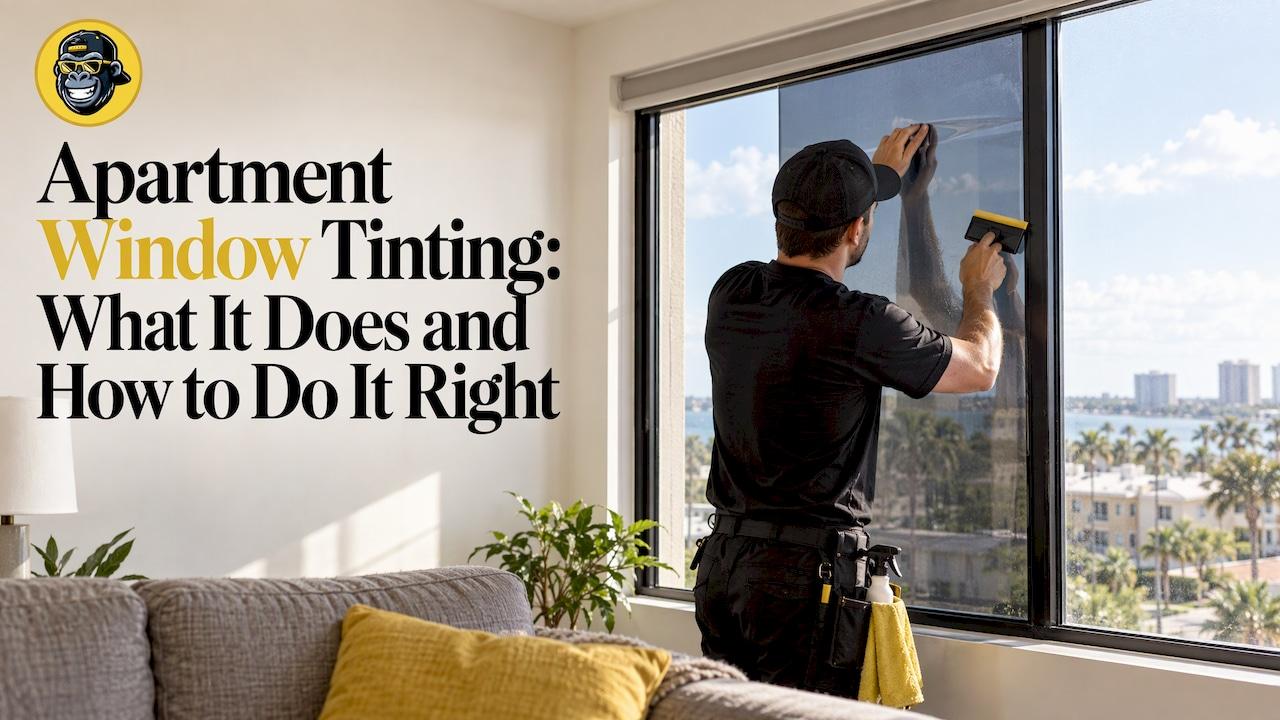
Apartment window tinting is a thin layer of film on the glass that cuts solar heat, glare and UV light while keeping the room bright. It works best when the right film is matched to the right window, permission is settled before anything goes on the glass, and a trained installer handles the fitment. In Volusia and Flagler Counties, we bring ceramic films to your door, so you do not have to rearrange your day around a shop visit.
TL;DR
- Window film can reduce solar heat gain by 50% to 75% and reject 95% to 99% of solar UV, according to the Whole Building Design Guide.
- Sun-facing apartment and condo windows gain the most: a cooler room, less glare on screens and less fading of floors and furniture.
- Adhesive film is not easy to adjust or remove, so get written approval from your landlord, condo board or HOA before you book.
- Mirror-style privacy film works in daylight only. At night you still need curtains or blinds.
- Film goes on best when the glass is prepped and fitted carefully, which is what a professional install is for.
Table of Contents
- What apartment window film actually does
- Which film fits an apartment or condo
- Before you book: permission comes first
- What apartment window tinting costs
- Why a pro install is worth it
- Wider glass upgrades versus film
- Removing film later
- Apartments, condos and the rest of the building
- Our perspective
- Book apartment and condo tinting at your door
- FAQ
- Sources
What apartment window film actually does
A window film is a layered sheet, usually 2 to 7 mils thick, made of an adhesive, a polyester base and a scratch-resistant coating, as BuildingGreen's guide to surface-applied films describes it. Once it is on the inside of the glass, it works on three things you notice every day.
Heat
Sunlight comes through glass as visible light, ultraviolet (UV) and infrared (IR). UV and IR are invisible, so blocking them does not darken the room. The Whole Building Design Guide explains that this is why a good film can cut heat while the space stays bright. It reports that high-efficiency films reduce solar heat gain by 50% to 75%, and that up to 80% solar heat rejection is obtainable.
For an apartment in Daytona Beach or Port Orange, where a west-facing living room can feel like a greenhouse by mid-afternoon, that matters. A cooler room means your air conditioner cycles less. Consumer Reports describes window film as a way to keep a home cooler and cut cooling costs.
UV and fading
The same WBDG page puts the UV figures side by side: window film rejects 95% to 99% of solar UV, while clear single-pane glass rejects only 23% to 28% and insulated glass 36% to 41%. Avery Dennison states that its dual-reflective films block over 99% of UV to prevent fading and damage.

Fading has several causes, and WBDG notes that UV and solar heat are the two a film can address. Hardwood floors, rugs, sofas, art and curtains near a sunny window are the usual victims.
Glare
BuildingGreen notes that films reduce glare and eye strain. If you work from home, watch TV in a bright room or fight a reflection on your monitor every afternoon, glare is often the first thing you feel improve.
Which film fits an apartment or condo
Not every film does the same job. Think of it in four groups.
| Goal | Film type | What to expect |
|---|---|---|
| Cooler rooms, less fading | Solar control film | Cuts heat and UV. Neutral versions add a subtle grey look and keep the natural view, per Avery Dennison. |
| Privacy from the street | Reflective or decorative film | Reflective films give daytime privacy. Decorative films diffuse the view for bathrooms, entry glass and sidelights. |
| Break-in and impact resistance | Safety and security film | Holds glass together if it breaks. Useful for ground-floor and patio doors. |
| Mixed goals | Layered or spectrally selective film | Balances heat rejection with clarity. |
We offer solar control, decorative, and safety and security films through our architectural window film page, and a dedicated residential window tint service.
The privacy question: seeing out but not in
This is the most common question about apartment film. A one-way mirror film works by reflection. Rock Rose Film's product documentation states that its silver reflective film gives daytime privacy when it is brighter outside than inside, and blocks up to 99% of UV. It also says the effect weakens at night, so you need curtains, blinds or shades for full privacy.
That is physics, not a flaw in one brand. After dark, with lights on inside and the street dim, people outside can see in through any reflective film. Plan for it: choose the film for daytime privacy and heat, and keep a window covering for evenings.
Highly reflective films can also create a mirror effect inside at night, which BuildingGreen flags as something to consider when choosing a shade. If privacy is your main goal for a front door, entry sidelight or bathroom, a decorative film that keeps light flowing is often the better fit. We cover those cases in our guides to front door glass privacy and window film for bathrooms.
Before you book: permission comes first
Film changes how the glass looks from the outside and, in most cases, it cannot be adjusted or easily removed once applied. BuildingGreen says this plainly. So the first step in any apartment or condo project is not choosing a film. It is getting approval.
If you rent
- Read the alterations or modifications clause in your lease.
- Ask your landlord or property manager in writing, by email, whether window film is allowed. Describe the film (clear, neutral, reflective or decorative) and say it is installed by a professional.
- Keep the written reply. If the answer is yes, keep it with your lease records.
- Photograph each window before the install, so the condition at move-in and move-out is documented.
- Ask whether the building has rules about window coverings or exterior appearance.
If your landlord says no to permanent film, respect that. A lease violation costs far more than any energy savings.
If you own a condo or live under an HOA
Because film changes how the glass looks from outside, associations commonly set limits on tint darkness and reflectivity, and some restrict mirrored or metallic looks. The sensible path is to read your governing documents (the declaration, often called the CC&Rs), then ask the board or the architectural review committee for approval, bringing the film's specifications and a sample if you can.
A neutral, low-reflectivity solar control film is usually the easiest to get approved, because it barely changes the exterior look. When you book with us, tell us your building's rules and we will talk through film options that fit.
Check your windows
Windows in some buildings have special glass, seals or manufacturer warranties. Film adds heat absorption in some cases, so ask the property manager about any glass restrictions. It is also worth noting that films do not reduce air leakage, which is a job for weatherstripping and sealing.
What apartment window tinting costs

We do not publish set prices, because cost depends on how many windows you have, their size, the film and how reachable the glass is. For context, BuildingGreen's guide put average total costs for a 30-by-60-inch window at about $10 for do-it-yourself film, $80 for standard solar control film and $125 for spectrally selective film. That guide dates from 2011, so treat it as a ratio between film grades rather than a current quote. Labor and material prices have moved since.
What drives the price today:
- Film grade. Basic dyed film, metallized film and ceramic film sit at different price points, and so do their heat and UV performance.
- Number and size of windows. Large sliders and floor-to-ceiling glass take more film and more time.
- Glass type and condition. Prep is a bigger task on older or very dirty glass.
- Access. Upper floors, balconies and awkward angles add time.
- Purpose. Decorative and security films are priced differently than solar films.
The quickest way to a real number is a quote for your windows. Count them, note which direction they face, and have photos ready.
Why a pro install is worth it
Film looks simple. Consumer Reports notes that first-time installers should expect to use more film than needed while learning, and that is just the material cost of the learning curve. What goes wrong with film on glass is usually in the prep and the fitment: dust under the film, trapped bubbles, creases, edges that do not sit evenly against the frame, and a gap that lets light leak around the border.
The temperature and the sun matter too. 3M's guidance says film can be applied year-round but not when the outside temperature is below 40°F, and that condensation can compromise adhesion. It also recommends applying film when the window is not in direct sunlight. In an apartment with a window wall that faces the afternoon sun, timing the work around the light is part of the job.
Our approach is built around that work:
- Meticulous prep and fitment. We do not rush jobs.
- Ceramic-only premium film. Our films are designed to reduce heat, UV exposure and glare while improving comfort.
- Mobile service. Our fully equipped mobile units come to the location you choose, so you do not take time off to sit in a waiting room.
- Warranty support. Our warranty is comprehensive and includes no-fault coverage.
If you are curious what a careful install looks like in detail, our guide to what a professional ceramic tint job involves walks through it.
Wider glass upgrades versus film
Some residents wonder whether they should upgrade the windows themselves. Replacement is something an owner generally does only when the frames and glass need it anyway, and it is a major project. If you are comparing glazing upgrades, how argon-filled windows work is a useful starting point for understanding insulated glass. For an apartment or condo you rent or share walls in, film is the lighter-touch way to improve the glass you already have, because it adds UV and solar control without replacing a frame or touching the building envelope.
Removing film later
It helps to know the exit before you start. 3M's guidance for removal is to peel one corner slowly and use window cleaner and a razor blade or metal scraper for any adhesive left behind. ComforTech's instructions add that you can loosen the adhesive with a hair dryer or hand steamer, avoiding one hot spot to prevent glass breakage, then peel in large pieces and scrape residue while keeping the glass wet.
The point for a renter: removal is a task that takes care and time, and the glass is the landlord's. Settle in your written approval who is responsible for removal at move-out.
Apartments, condos and the rest of the building
Our work reaches beyond a single unit. Property managers and owners with common spaces, leasing offices or ground-floor retail often ask about glare and heat in those areas. Our guides to office window tinting, storefront window tinting and business window tinting cover those cases, and our commercial window tint service handles them.
Our perspective
We install a lot of film, and the happiest customers share one thing: they decided what they wanted the glass to do before they picked a film. Heat, glare, UV, privacy or security each call for a different product.
For most apartment and condo windows facing the sun, we point people to ceramic film. It is designed to cut heat and UV without turning the room dark or giving the glass a heavy mirrored look, which is also the look that gets a board's attention.
We also believe the installation is half the product. Careful prep, a clean fit along the edges and unhurried work are what make film look like part of the window. That is why we run fully equipped mobile units and take the time each job needs, and why our warranty includes no-fault coverage.
Tint
Book apartment and condo tinting at your door
We handle residential window tinting across Volusia and Flagler Counties, including Daytona Beach, Port Orange, Ormond Beach, New Smyrna Beach, DeLand, Deltona, Palm Coast and Edgewater. Our mobile team comes to you, installs ceramic film with careful prep and fitment, and backs the work with warranty support. Start with our residential window tint page to request a quote once you have your building's approval.

If you also drive a car that bakes in the Florida sun, we tint vehicles the same way, and you can see the options on our automotive tint page. Dealerships can ask us about our dealer programs.
FAQ
Can I tint my apartment windows?
Only with your landlord's written permission. Most leases restrict alterations, and adhesive film is not easy to remove. Send an email describing the film and the professional install, and keep the reply with your lease.
Does apartment window film really lower the AC bill?
It can. Window film reduces solar heat gain by 50% to 75% according to the Whole Building Design Guide, and cooler rooms mean less cooling work. The size of your savings depends on how much sun your windows get, which way they face and how your unit is cooled.
Can people see in at night through privacy film?
Yes. Reflective films give daytime privacy because the outside is brighter than the inside. At night, when your lights are on, the effect fades, so use curtains, blinds or shades for evening privacy. Decorative films that diffuse the view are a good choice where you want privacy around the clock.
Do condos and HOAs allow window tint?
Many do, within limits. Associations commonly restrict tint darkness, reflectivity and mirrored finishes because film changes the exterior look. Read your CC&Rs, then submit the film specifications to your board or architectural review committee before installation.
Does film hurt my windows or fade my floors less?
Film is applied to the glass surface, and it cuts the UV and heat that contribute to fading. WBDG reports film rejects 95% to 99% of solar UV, which helps protect floors, furniture and art near sunny windows.
Sources
- Window Film Fundamentals, Whole Building Design Guide
- Surface-Applied Window Films, BuildingGreen
- Architectural Window Film Design Guide, Avery Dennison
- One-Way Mirror Window Film, Rock Rose Film
- Best Window Films for a Cooler Home, Consumer Reports
- Sun Control Window Films, 3M United States
- Film Removal Instructions, Window Film (ComforTech)