
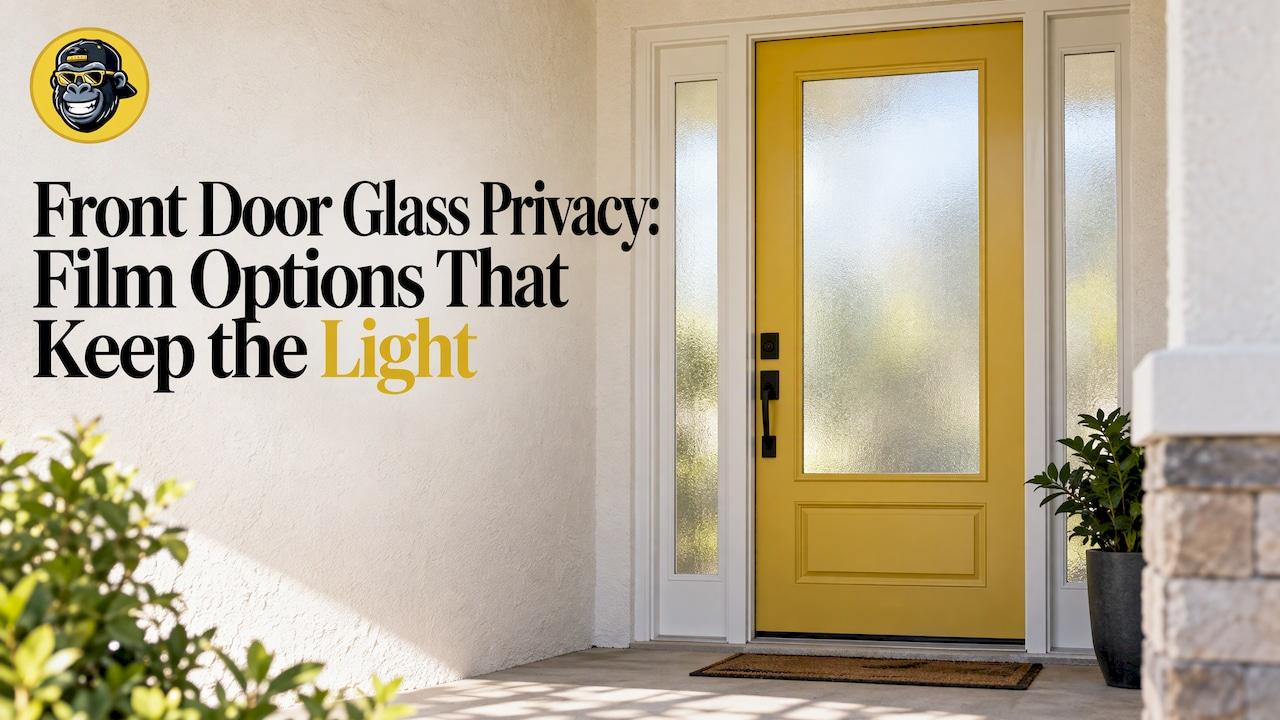
The cleanest way to add privacy to a glass front door is a professionally installed window film applied to the glass you already have. It frosts, patterns or tints the panel, keeps daylight coming into the entry, and avoids the cost and wait of replacing the door. In Volusia and Flagler Counties, Tint Monkeys brings that work to your driveway with a mobile unit, so the door never leaves the house and you don't rearrange your day.
This guide explains which film styles suit a front door, what each one does during the day and at night, and what to decide before you book.
TL;DR
- Frosted or decorative film gives privacy around the clock and still passes soft daylight. It is the usual pick for a front door and its sidelights.
- Reflective or dark tinted film looks like a mirror from outside in the daytime, but at night it can work in reverse when your hall lights are on.
- Film applies to your existing glass, so you keep the door, the frame and the look of the entry.
- Solar-control films add UV and heat reduction, which helps a sun-baked Florida entry stay more comfortable.
- A mobile installer works at your home, so you don't have to remove the door or take a half day off.
Table of Contents
- Why front door glass needs a privacy plan
- The film styles that work on a front door
- Day and night: what people outside will see
- Privacy is only half the benefit: UV, heat and glare
- What to decide before you book
- Why professional installation is worth it on a door
- Door glass for dealerships and busy owners
- Our perspective
- Book front door privacy film in Volusia and Flagler
- Mistakes to avoid when choosing privacy for a front door
- FAQ
- Sources
Why front door glass needs a privacy plan
Glass in a front door is there for light and curb appeal. The trade-off is that anyone on the porch, or walking past, can see into your entry hall, and often straight through to the living room. Sidelights, the tall narrow panes on either side of the door, and transoms above it have the same issue.
The problem is rarely the glass itself. Most people like the brightness. They want to stop the view-in without turning the entry into a dark box. That is why the question is less "how do I block the glass" and more "how much do I want to see, how much light do I want to keep, and what should it look like from the street".
There are four common ways to answer that:
- Film on the existing glass (frosted, decorative, reflective or tinted).
- Replacing the glass with a textured or privacy-rated panel.
- Soft coverings such as shades, blinds or curtains.
- Electric switchable glass built into a new door system.
Of these, film is the one that keeps your door, keeps your daylight and finishes in a single visit. Replacement glass means a new panel or a new door. Coverings need to be opened and closed daily and block light when closed. Switchable glass is part of a planned door project. Film is the only option that is both permanent in feel and fitted to the glass you already own.
The film styles that work on a front door
Architectural window film is a thin, multi-layer film applied to the inside of the glass. It comes in several looks, and the look you choose sets how much light and visibility you keep. Pick by what you want to see from inside and what you want strangers to see from outside.
Frosted film: soft, even privacy
Frosted film gives glass a milky, etched appearance. Light passes through but the shapes behind it blur, so someone on the porch sees a glow and not your hallway. Because it diffuses light rather than reflecting it, the privacy holds day and night. Nobody outside can pick out details at 2 a.m. when the lamp is on.
This is the most common choice for sidelights and for glass panels that sit at eye level. The trade-off is that you also lose a clear view out. If you want to see who is at the door, frost the lower or side panels and leave a small clear area, or choose a pattern.
Decorative and patterned film: privacy with a design
Decorative film imitates specialty glass: reeded, rain, gradient, stripe, or leaded-look patterns. These films give you the privacy of frosting with a visible design that suits the architecture of the house. A fine gradient that is dense at the bottom and clearer at the top is a popular way to protect eye-level privacy while keeping the top of the door bright.

Tint Monkeys lists decorative films among its architectural film services, alongside solar control and safety and security films, so a front door can get its privacy pattern and be cut and fitted in one appointment.
Reflective film: a mirror by day
Reflective film bounces light back from the outside, so in the daytime the glass looks like a mirror to people on the porch while you still see out. Designers who deal with glass doors point to reflective film as a good route when replacing the glass is not an option, as Southern Living reports.
The catch is physics, not the film. The brighter side of the glass looks more reflective. At night, when your entry is lit and the street is dark, the effect reverses: people outside can see in, and you see mostly your own reflection. If your priority is privacy after dark, frosted or decorative film is the better match. Reflective suits a door that faces strong sun and where daytime privacy and heat reduction matter most.
Tinted and ceramic solar-control film: privacy plus comfort
Tinted film darkens the glass. Light tints give a little privacy; darker ones give more. Ceramic films are made to reject heat and UV without depending on a heavy dark look, which is why they are the standard for cars and a growing choice for homes. Tint Monkeys uses ceramic films, designed to reduce heat, UV exposure and glare while improving comfort.
A front door that faces south or west is a heat and glare spot. Films there do double duty: the privacy you wanted, and a calmer, cooler entry.
Day and night: what people outside will see
Before you choose, think about the two moments that matter. One is a sunny afternoon with a visitor on the porch. The other is an evening with your lights on.
| Film style | Daytime privacy | Night privacy with lights on | Daylight kept | Best for |
|---|---|---|---|---|
| Frosted | High | High | Soft, diffused light | Sidelights, door panels, everyday privacy |
| Decorative / patterned | Medium to high, depends on the pattern | Medium to high | Good | Entries where design matters |
| Reflective | High (mirror effect) | Low, can reverse | Reduced | Sun-exposed doors, daytime privacy |
| Dark tint | Medium to high | Low to medium | Reduced | Heat and glare control with some privacy |
| Light ceramic | Low | Low | High | UV and heat reduction with little privacy change |
The pattern is consistent. Anything that works by reflection loses its privacy when the inside is brighter than the outside. Anything that works by diffusing the light keeps it. If you choose reflective film for its heat control, you can pair it with a lined curtain or shade at night. If you want privacy to be automatic, choose frosted or decorative.
Privacy is only half the benefit: UV, heat and glare
Glass lets in more than light. The U.S. Department of Energy notes that heat moving through windows can raise heating and cooling bills, and its homeowner guide lists sun-control window film among the ways to reduce heat gain. In Volusia and Flagler Counties, where the sun is strong most of the year, an entry door with a big pane of clear glass is a place where heat and fading come in.
Solar-control film is made to address exactly that. Depending on the product, it cuts UV, reduces glare and rejects part of the sun's heat. You will feel it on your arms by the door, and you may notice it on the flooring and furniture that the afternoon sun used to hit. If a lower AC bill is part of your reason, the door is a small piece of the picture. Windows throughout the house matter more, and a single visit can cover the door, the sidelights and the larger panes. Our home window tint guide for Daytona Beach goes through film, rules and cost for the whole house.
When you compare films, look at the figures the maker publishes for each product: visible light transmitted (how much daylight gets through), UV blocked, total solar energy rejected and glare reduction. Those numbers describe the film on a stated glass type, so the same film performs a little differently on your own door. We take the glass into account when we recommend a film.
What to decide before you book
A front door is a small job with a few choices that are easy to settle in advance.
Which panes get film
Most homes need film on the door glass and the sidelights, sometimes a transom. For a consistent look, treat them as one set. A frosted door next to clear sidelights looks like a mistake. Decide whether you want full coverage or a band at eye level, and whether you want to keep a clear strip to check who is outside.
What kind of glass you have
Film goes on the inside of the glass in most homes. The type of glass matters for how well a film performs and whether it is compatible. Door glass can be single-pane, double-pane or a decorative insert with beveled or leaded pieces. If your glass is already textured or patterned, describe it when you reach out so the film recommendation fits.
How much light you want to keep
Picture your entry at 8 a.m. and at 6 p.m. If the hall is dark without the door glass, choose frosted or a light decorative film. If the hall is bright and hot, go with ceramic solar control and accept a darker look.
The look from the street
Stand at the curb. Frosted glass reads as clean and modern. Reeded and gradient patterns read as designed and architectural. Mirror finishes read as commercial. Pick what suits the house and the neighborhood, and check any HOA guidelines on exterior appearance before you decide.
Why professional installation is worth it on a door
A front door is the most visible piece of glass on your property. Bubbles, dust specks, a crooked edge or a trimmed line that wanders will be seen every day by you and every guest. Film on small panes such as sidelights is also less forgiving than it looks: the edges are close together, and the cut has to be exact.
Our approach to installation is built around the details a front door shows off: meticulous preparation of the glass, careful fitment, and a clean finish without rushing the job. Our mobile units are fully equipped, and the work happens at the address you choose. That means no dropping the door off, no removing hardware, and no waiting around at a shop. You can be at home, or at work, and the door is finished when you come back to it.
The same crew and the same visit can cover other glass at the property. If you also want privacy in a bathroom, our guide to window film for bathrooms explains how privacy and light work together in a smaller room. And if you run a business with a glass entrance, see our notes on storefront window tinting and office window tinting, where glare and visibility from the street are the main goals.
Door glass for dealerships and busy owners
The same logic applies when the door in question is a showroom entrance or a customer-facing office. Film can reduce glare at a service counter, hide a back office from the lot, and cut UV that fades displays. Mobile service helps here too: work can be scheduled around business hours without closing a door or moving a vehicle. Tint Monkeys also runs dealer programs for dealerships in Volusia and Flagler Counties.
For busy households the point is the same. If you don't have time for a shop visit for your car, you don't have time to take a door off its hinges either. A mobile visit fits into the day you already have.
Our perspective
We tint cars, homes and businesses, and we see the same pattern on every glass surface: people don't want less light, they want control over who can see in. Film is how you get that control without changing the glass.
For a front door, we lean toward frosted or decorative film because the privacy works whether it is noon or midnight, and nobody has to remember to close anything. Where the door takes a lot of Florida sun, we pair that thinking with ceramic solar-control film, which is designed to reduce heat, UV and glare and keep the entry more comfortable.
The finish is what people notice on a front door, so we put our time into preparation and fitment, and we don't rush. It is the same ceramic-only, premium-film approach we bring to vehicles, brought to your doorstep with a fully equipped mobile unit.
Tint
Book front door privacy film in Volusia and Flagler
If you want privacy on a front door, sidelights or a transom, we install decorative and solar control films at your home and can advise on the right look for your glass. Our residential window tint service covers the rest of your windows in the same visit, with a warranty that includes no-fault coverage. We serve Daytona Beach, Deltona, New Smyrna Beach, DeLand, Port Orange, Ormond Beach, Palm Coast, Edgewater and the surrounding area.

Tell us which door you have and what you want to keep private, and we will help you choose between frosted, patterned and solar-control film. Start at tintmonkeysdb.com.
Mistakes to avoid when choosing privacy for a front door
Choosing reflective film for night privacy. Mirror film looks great in daylight and can leave you exposed in the evening. If evenings are when you worry about the view in, choose frosted or decorative.
Frosting only part of the glass. A door with a frosted panel and a clear sidelight looks unfinished. Plan the whole entry as a set.
Going too dark. A very dark film on a door that faces a covered porch can make the hall gloomy. Match the film to how much light the entry already gets.
Forgetting the rest of the glass. The door is the visible piece, but heat and UV come through every window on the same side of the house. Doing the door alone is a start. Doing the sun-facing glass together is more comfortable and more consistent.
Ignoring the glass type. Film performance and compatibility depend on the glass. Tell the installer if your door has insulated, textured, leaded or beveled glass.

FAQ
How do I make my front door glass not see-through?
Apply a frosted or decorative privacy film to the glass. It blurs shapes while letting daylight in, and it works at night as well as during the day. A professional installation gives an even finish without bubbles or visible edges.
What is the best privacy film for a front door at night?
Frosted or patterned decorative film, because it diffuses light and doesn't depend on which side is brighter. Reflective film acts like a mirror in daylight, but with your lights on and a dark street it can let people see in.
Can I keep a view out and still have privacy?
Yes, in part. Reflective or tinted film lets you see out in the daytime while limiting the view in. For round-the-clock privacy, frosted film is stronger, and a clear strip or a gradient pattern keeps some visibility where you need it.
Will privacy film also help with heat and UV?
Solar-control films are designed to reduce UV, heat and glare, and the Department of Energy lists window film among the ways to cut heat gain through glass. The amount depends on the film, so choose one built for solar control if comfort is a goal.
Do you install door glass film at my home?
Yes. We bring a fully equipped mobile unit to your address in Volusia and Flagler Counties, so the door stays in place and you don't need a trip to a shop.
Sources
- U.S. Department of Energy, Tips on Saving Money and Energy in Your Home
- Southern Living, How To Add Privacy To Glass Doors While Keeping Natural Light