
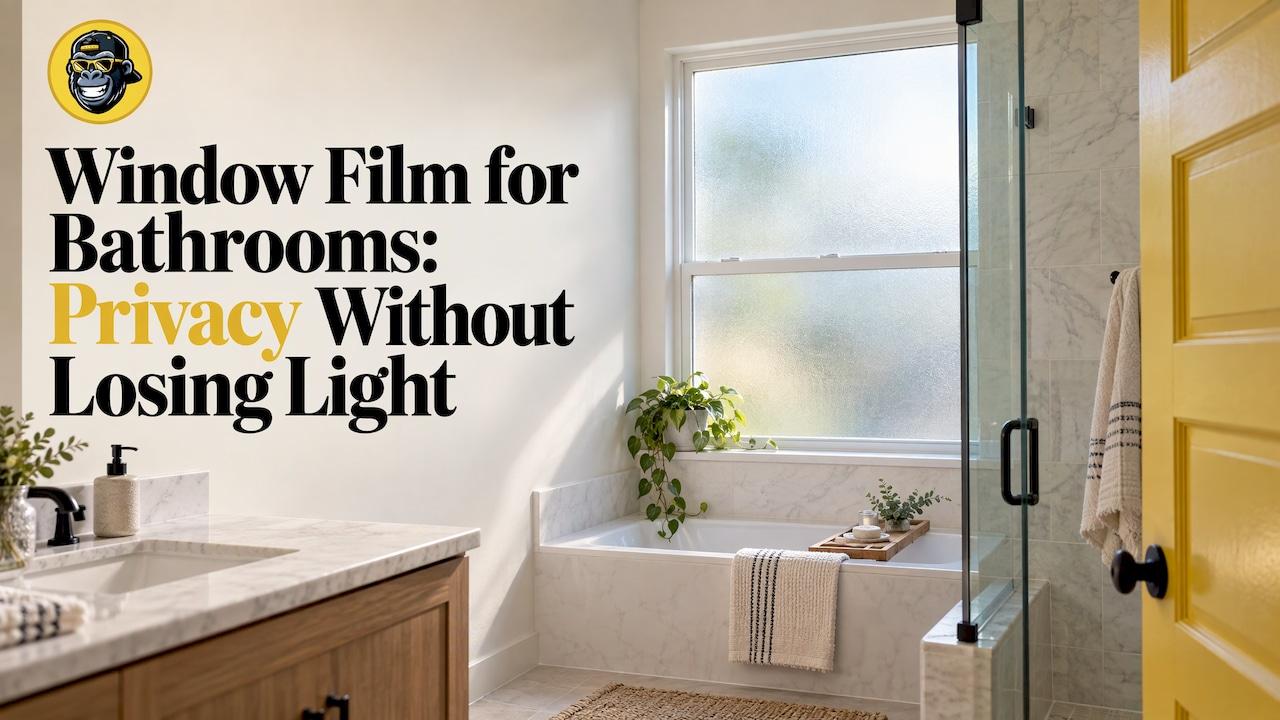
The best window film for a bathroom is a frosted, etched or whiteout finish applied to the glass. It blurs what people can see from outside and keeps the room bright, day and night. The film is only half the result. Fit, glass prep and edge sealing decide whether it still looks clean after a year of hot showers. That is why we install decorative and solar control films on-site for homeowners across Volusia and Flagler Counties, and why this guide covers the finishes, the privacy trade-offs and the moisture questions before you pick one.
TL;DR
- Frosted, etched and opaque films give privacy at any hour, because they scatter the view instead of relying on which side of the glass is brighter.
- One-way mirror film mainly protects you by day. At night, with the bathroom light on, the effect can reverse.
- Steam and spray are the real test for a bathroom. A clean fit with well-finished edges matters more than the pattern you choose.
- In Florida, solar control film can add heat and UV reduction on a sunny bathroom window while it handles privacy.
- We bring the installation to your home in Volusia and Flagler Counties, so you don't have to remove anything or visit a shop.
Table of Contents
- Why film works so well on bathroom glass
- How privacy film blurs a window and still lets light in
- Day and night privacy: which finish does what
- Choosing a look: patterns and finishes
- Steam, spray and moisture: what a bathroom demands of film
- A Florida bonus: heat, UV and glare in the bathroom
- Film, blinds, new glass or smart film: how to choose
- What a professional install looks like
- Book bathroom window film at your home
- Our perspective
- FAQ
- Sources
Why film works so well on bathroom glass
A bathroom window has a strange job. It needs to let in daylight so you aren't showering in a cave, yet it often faces a neighbor, a driveway or a sidewalk. Blinds solve that only when someone remembers to close them, and they collect moisture. Replacing the glass with obscure glass is permanent and costly.
Window film sits between those options. It is applied to the glass itself, so there is nothing to raise, lower or wipe down on a fabric slat. According to a bathroom film guide from a flooring and design company, film offers privacy while still allowing light, and it needs no daily adjusting. Blinds and shades give adjustable privacy, frosted-glass replacement is permanent, and switchable smart film can turn opaque on demand.
For most bathrooms, the simplest answer is a fixed, frosted look. You never think about it again.

How privacy film blurs a window and still lets light in
Frosted and etched-look films have a finely textured or diffusing surface. Light passing through gets scattered in many directions rather than traveling in a straight line. Your eye still receives the brightness, but the detail of what is on the other side is lost. A person standing outside sees a soft, milky glow where the shape of someone inside would otherwise be.
The difference between finishes is how much of that scattering they apply:
- Light frost: keeps more brightness, blurs detail and shape.
- Heavy frost or whiteout: diffuses much more, so the glass looks like solid white from either side.
- Opaque or blackout: blocks most or nearly all light. Privacy is total, but so is the loss of daylight.
The Bob Vila review of window films makes this same distinction: frosted films blur images, and whiteout and blackout films provide two-way privacy, with blackout blocking all or nearly all light. It also notes that translucent film obscures what is visible but does not necessarily remove every silhouette. If you want zero shadow at close range, step up from light frost to a denser finish.
Day and night privacy: which finish does what
This is where most buyers go wrong. A film can look perfect at noon and fail at 9 p.m.
| Film type | Daytime privacy | Nighttime privacy | Light let in |
|---|---|---|---|
| Light frosted | Good, blurs detail | Good | High |
| Heavy frosted or etched | Very good | Very good | Medium to high |
| Whiteout or opaque | Excellent | Excellent | Low to medium |
| Blackout | Excellent | Excellent | Almost none |
| One-way mirror (reflective) | Good | Can reverse | Medium |
The logic behind the last row is simple. Reflective film works because the bright side of the glass hides the dim side. In daylight, the outside is brighter, so people outside see a mirror. After dark, with your bathroom lights on and the yard dark, the roles flip and someone outside may see in, as this guide to bathroom window film options explains. By contrast, it notes that frosted, etched and opaque films provide privacy in both daytime and nighttime conditions, because their effect does not depend on which side is brighter.
For a bathroom, where the lights come on at night, we steer people toward frosted or decorative finishes rather than mirror film. Mirror film is a better fit for a living room or office window that you mainly care about during the day.
Choosing a look: patterns and finishes
Privacy is the job, but the window is also part of the room's design. A few directions homeowners pick:
- Uniform frost. A clean, even, etched-glass look. It suits modern and traditional bathrooms alike and is the safest choice.
- Gradient or band. Frost on the lower portion of the glass, clear above. You keep a view of sky and treetops while blocking sightlines from the ground. It works well on tall windows.
- Pattern or texture. Linen, reeded or geometric patterns add character and can hide a bland window.
- Whiteout. For a window that sits right beside a toilet or shower on a ground-floor side wall, where you want nothing readable from outside.
Our decorative films are listed alongside our solar control and safety and security films on the architectural page, so you can see the families of film we install for homes and businesses.
Steam, spray and moisture: what a bathroom demands of film
The bathroom is the hardest room in the house for any film. Warm, saturated air meets glass every day, and a window next to a shower may take direct spray. Three things matter.
The film's adhesive and construction. Films designed for humid spaces handle steam better than a casual, easily lifted product. Edges are where trouble starts: if moisture creeps under a corner, it can lift or bubble over time.
The prep. Glass has to be spotless before film goes on. Soap residue, hard-water film and invisible oils keep adhesive from bonding evenly.
The edges. Tight, precise edges keep steam out. A sloppy trim line is the first place a bathroom film shows its age.
A window next to a shower deserves particular attention. Bath Experts advises choosing privacy film designed for high-humidity environments and making sure the frame-to-wall transition is sealed and the sill slopes to drain. The same article points out that a shower window's long-term concern is not only visibility but moisture getting behind the wall surface, which can lead to mold, wood rot and frame deterioration. Film is a surface treatment. It is not a substitute for a properly sealed window, so a shower window with soft or stained trim should get that fixed alongside the film.

Installation quality counts beyond the glass, too. The U.S. Department of Energy's window performance guideline says that improper installation can contribute to air leakage, condensation and water leakage, and may eventually deteriorate walls, insulation and the window unit. That is a good reason to treat a bathroom window as an assembly and to hire an installer who looks at the whole opening rather than just rolling out a sheet.
Care after installation
Good bathroom film is low maintenance. Wipe it with a soft cloth and mild soapy water, or an ammonia-free glass cleaner, and avoid abrasive pads and scrapers. Run the exhaust fan during and after showers, because less lingering humidity means a longer-lasting finish on any surface in the room, film included. We also provide warranty support on our installations, so you have a place to go if you ever see an issue.
A Florida bonus: heat, UV and glare in the bathroom
Bathrooms in Daytona Beach, Port Orange, Ormond Beach and Palm Coast often have west or south windows that bake in the afternoon. A privacy-only film solves the visibility problem. A solar control film can also cut heat, UV and glare at the same time, so the room stays more comfortable and the window works harder for you.
If the same house has other sun-baked windows, it often makes sense to look at the whole picture at once. Our guide to home window tint in Daytona Beach covers film, cost and local rules for the rest of the house, and our residential window tint page shows what we do for homes.
Film, blinds, new glass or smart film: how to choose
| Option | Privacy | Light | Upkeep | Permanence |
|---|---|---|---|---|
| Frosted or decorative film | Constant | Soft, bright | Wipe clean | Long-lasting once applied |
| Blinds or shades | Adjustable | Depends on position | Collect moisture and dust | Easy to swap |
| Obscure glass replacement | Constant | Bright | Wipe clean | Permanent, higher cost |
| Switchable smart film | On demand | Clear or opaque | Needs power | Specialty product |
The same bathroom film comparison suggests weighing moisture, night privacy, glass compatibility, removability, maintenance and sightlines. Applied to a typical bathroom, that comes out as follows:
- You want privacy that never needs managing: frosted film.
- You want a view of the sky but not the street: a gradient or lower-band pattern.
- The window faces hot afternoon sun: a film with solar control properties.
- The window is inside the shower: a humidity-rated film and a sealed frame, installed carefully.
- You rent or may change your mind: talk to us about the right film for the situation before you commit.
Film does reduce the clear view out of the glass, which is the point of a bathroom window. If you want the outside visible from inside, a lighter frost or a lower-band pattern keeps part of it.
What a professional install looks like
Bathroom jobs reward patience. The glass is cleaned and prepped, the film is measured and cut to fit the pane, and it is applied with attention to edges and corners so no gaps invite steam. Done properly, nobody should notice the film except as a soft, even finish.
Our work is built around that approach: meticulous prep and fitment, premium film, and no rushing. Because we work through fully equipped mobile units, we arrive at your home in Volusia or Flagler County, so a bathroom job doesn't mean moving anything or taking time off.
Book bathroom window film at your home
If you are ready to deal with a bathroom window, Tint Monkeys comes to you in Daytona Beach, Deltona, New Smyrna Beach, DeLand, Port Orange, Ormond Beach, Palm Coast, Edgewater and the surrounding area. We install decorative, solar control, and safety and security films for homes and businesses, and our team can help you match a finish to the way your bathroom is used.

Start on our architectural films page to see the film families, or go straight to our mobile window tinting page to request a visit.
Our perspective
Most bathroom window problems we hear about start with the wrong finish or a rushed job. A mirror-type film that looks great at noon leaves people exposed after dark. A film applied to a dirty pane lifts at the corners within weeks.
We believe the answer is a finish matched to how the room is used, put on with careful prep and clean edges. That is the standard we hold ourselves to on every window, in every home we visit.
It is also why we come to you. Seeing the actual window, the light it gets and what faces it lets us recommend frost, whiteout or a solar control film that handles the Florida sun too. Our mobile units carry what the job needs, and our warranty support stands behind the work.
Tint
FAQ
Is window film suitable for bathrooms?
Yes. Bathroom film is a common, practical way to get privacy while keeping daylight. Choose a frosted, etched or whiteout finish designed for humid rooms, and make sure the glass is properly cleaned and the edges are finished well.
What is the best window treatment for a bathroom?
For most bathrooms, it is a fixed frosted or decorative film, because it gives privacy at all hours with nothing to adjust. Blinds are adjustable but collect moisture, and replacing the glass is permanent and costlier. If the window gets strong afternoon sun, a film with solar control properties adds comfort.
How do I blur my bathroom window?
Apply frosted film to the glass. Its textured surface scatters light, so you get daylight but outsiders see only a soft blur. A denser frost or whiteout gives stronger privacy, and a light frost keeps the room brighter.
Will bathroom window film work at night?
Frosted, etched and opaque films do, because their effect doesn't depend on which side is brighter. One-way mirror film can be see-through at night when the indoor lighting is brighter, so we suggest frosted finishes for bathrooms.
Can film go on a window inside the shower?
Yes, with a film designed for high humidity and a well-sealed frame. Careful prep and clean edges matter most there, and we can look at the window with you during a visit.
Sources
- Bathroom Window Film: Privacy Options That Last
- The Best Window Films: Top Picks from Bob Vila
- Shower Window Solutions & Design Ideas: Bath Experts
- Measure Guideline: Energy-Efficient Window Performance and Installation, U.S. Department of Energy