
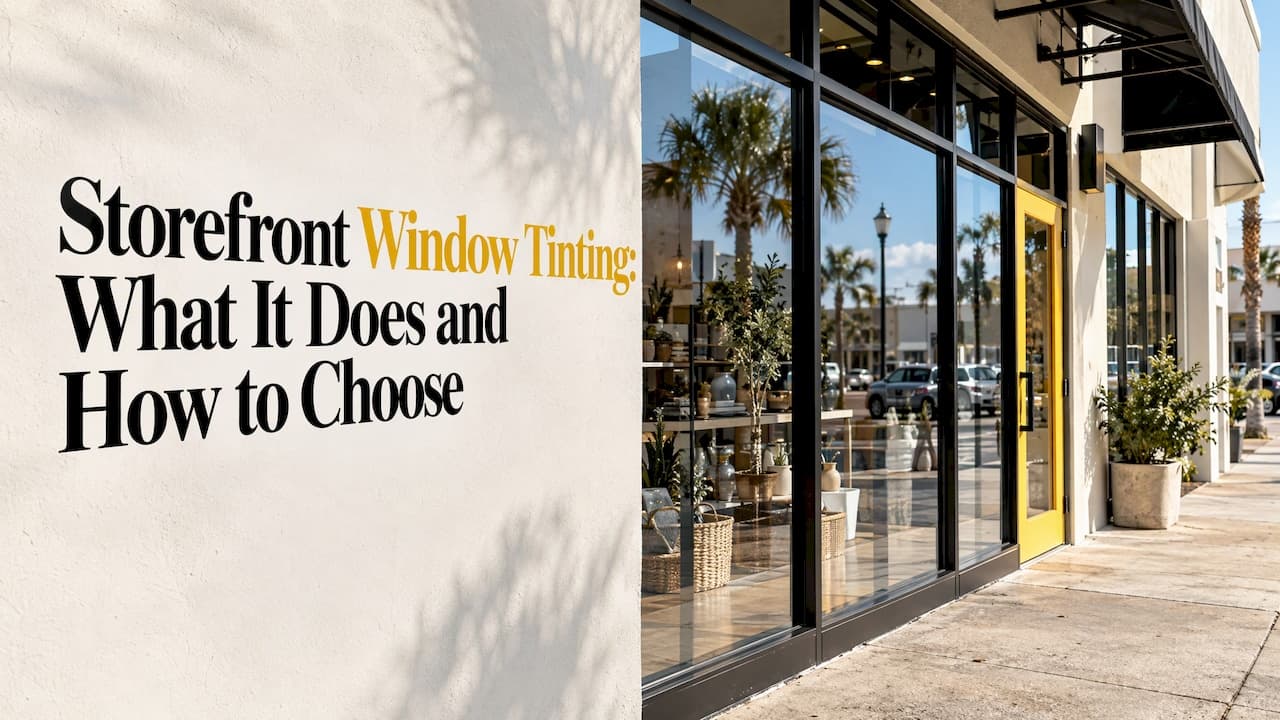
Storefront window tinting is a clear or lightly shaded film applied to your shop or restaurant glass. It cuts solar heat, glare and UV, and it keeps your display visible from the sidewalk. In Central Florida, where a west-facing wall of glass can turn a dining room or sales floor into an oven by mid-afternoon, it is one of the simplest upgrades a business can make. It also needs no remodel and no downtime. We install ceramic and architectural films on site across Volusia and Flagler Counties, so you can keep your doors open while the work gets done.
This guide explains what storefront film does, which types suit retail and restaurants, what to check before you commit, and what a clean installation looks like.
TL;DR
- Storefront film reduces heat, glare and UV on glass you already have. It protects inventory, furniture and floors from fading and makes the space more comfortable for staff and customers.
- Pick the film by goal first: solar control for heat and glare, decorative film for privacy and branding, safety and security film for break-in and impact resistance.
- Check your glass type (insulated, tempered, low-E) before film goes on. A professional should confirm compatibility and warranty terms.
- Mobile installation means we come to your business, with no moving stock and no closing for a day.
- For a quote on your storefront, use our free quote form.
Table of Contents
- What storefront window tinting does for a business
- Types of storefront film and when each fits
- How to choose the right film for your storefront
- What to check before film goes on your glass
- Common misconceptions about storefront tint
- What installation looks like with a mobile team
- Perspective
- Tint your storefront without closing the doors
- FAQ
- Sources
What storefront window tinting does for a business
A storefront is mostly glass, and glass lets in everything the sun sends: visible light, infrared heat and ultraviolet radiation. Window film sits on the glass and filters part of that load before it reaches your room.
For restaurants, 3M describes film as a cost-effective, long-lasting and nearly invisible way to address glare, fading furniture, heat, cold and rising utility costs without a costly remodel. Retail owners face the same list with different victims: shelves of product, mannequins, signage and flooring instead of booth upholstery.
Here is what that looks like day to day.
Heat and air conditioning
The hot spot near the window is a familiar problem. Customers avoid the table by the glass, and the AC runs hard to compensate. Spectrally selective films target the infrared part of sunlight. In a 3M retail case study, the manufacturer reports that its Prestige Series films reject up to 97% of the sun's heat-producing infrared light. Those are manufacturer figures for a specific product line, and your results depend on your glass, exposure and the film you choose. The principle holds across quality films: less solar heat entering means less work for your cooling system.
Glare
Glare hurts a restaurant when guests squint at menus and a retail store when sun washes out screens, price tags and the point-of-sale display. A film with the right visible light transmission softens the brightness without turning the shop into a cave.
UV and fading
UV is the quiet cost. The same 3M study says its Prestige films block 99.9% of UV rays, which it ties to about 40% of fading. Fading is not only UV, since visible light and heat also play a part, so film slows the damage rather than stopping it completely. If you sell apparel, books, art or furnishings near the glass, that slowdown protects inventory you have already paid for.
Privacy and curb appeal
Decorative film can frost a lower section of glass, add a pattern or carry a logo. Offices, salons, clinics and back-of-house dining areas often use it for privacy while the upper glass stays clear.
Safety and security
Safety and security films hold glass together when it is struck. They do not make glass unbreakable, but they help keep fragments in place. Storefronts in busy corridors like Daytona Beach's beachside streets or Palm Coast's shopping centers often consider this layer alongside solar control.
Types of storefront film and when each fits
You do not need to memorize product names. You need to match the film to the job. Our architectural offer is grouped the same way: solar control, decorative and safety and security films.
| Goal | Film type | Best for | What you notice |
|---|---|---|---|
| Cut heat, glare and UV | Solar control (ceramic or spectrally selective) | Restaurants with afternoon sun, retail with sun-facing windows, offices | Cooler space, softer light, less fading |
| Privacy or branding | Decorative (frosted, patterned, custom graphics) | Salons, clinics, offices, restaurants with street-side seating | Controlled sightlines, a finished look |
| Break-in and impact resistance | Safety and security | High-traffic storefronts, glass doors, low-level glass | Glass is held together if struck |
| Mix of the above | Layered or combined solutions | Businesses with several problems at once | Depends on the pairing |
Solar control film
This is the most common choice for storefronts in our area. Ceramic-type films work on heat rejection without relying on a dark, mirrored look. That matters when your window is your advertising: you want people to see the display, not their own reflection. We focus on ceramic films because of the balance they strike between heat control, clarity and appearance.
Decorative film
Decorative film solves different problems. It hides clutter behind a counter, adds a see-through-but-private band at eye level, or places your name on the glass. It can be paired with solar control when heat is also an issue.
Safety and security film
This film is thicker and made to hold glass together. If your storefront has large panes at street level, ask us about it when you request a quote.
How to choose the right film for your storefront
Start from the problem you notice, not the product.
- Name your top problem. Hot tables, bleached merchandise, screen glare, a nosy view into a treatment room, or a worry about break-ins. One answer usually points to one film family.
- Look at exposure. South and west glass takes the most punishment. A north-facing window may need little more than UV protection.
- Decide how clear you want the glass. A boutique showing a window display wants high clarity. A dental office may want more privacy.
- Think about the look from outside. Some films read slightly reflective in daylight. Ask to see a sample against your glass in real light.
- Check the building. Landlords, HOAs and plaza managers sometimes have rules on exterior appearance. Ask before you book.
- Plan for the schedule. Because we come to you, installation can be set for before opening, after closing or a quiet stretch of the day.
Restaurants
A restaurant usually wants three things: comfortable seating near the windows, protection for furniture and flooring, and a lower cooling bill. A solar control film is the natural match. If your front windows also look onto a parking lot, a light decorative band can add privacy to the first few feet of seating.
Retail stores
Retail adds merchandising to the list. You want the display to look right at every hour. That calls for a film with good clarity and low reflectivity, so the product stays the star. Add UV protection for anything that fades.
Offices and service businesses
Salons, clinics and professional offices often lean toward decorative or privacy film, with solar control as a bonus on the glass facing the sun.
What to check before film goes on your glass
Storefront glass is not all the same, and the details matter more than most owners expect.
Glass type
Insulated glass units, tempered glass and low-E coatings each handle absorbed heat differently. Film that absorbs more solar energy raises the temperature of the pane, which can add thermal stress. That is why film makers publish glass-compatibility guidance, and why we review your glass before recommending a product. In some cases an exterior film is the better route. If you are unsure what your windows are, a quick look at the edge markings or a conversation with the installer will tell you.
Warranty terms
Film warranties come in two layers: the film itself, and, in some programs, glass breakage from thermal stress. They also come with exclusions. For example, one major manufacturer's commercial warranty offers 15 years on the film and 5 years on glass failure from thermal stress, while excluding glass types such as triple pane, laminated, textured or wire glass. Terms differ by brand, so read the warranty that applies to your film and glass. Our own installations come with a comprehensive warranty that includes no-fault coverage, and we will walk you through exactly what it covers.

Local rules and lease terms
Florida's sun makes energy performance a real concern, but your lease, your plaza's design standards or a historic district may decide what you can put on the glass. Check those first. For anything involving building code or permits, your city or county building department is the authority to ask.
Installation quality
The best film can still look poor if the install is poor. Dust under the film, edge gaps, bubbles and lifted corners usually come from rushed prep. We clean and prepare the glass thoroughly and take the time to fit each pane, because the finished edge line is what customers and staff will notice for years.

Common misconceptions about storefront tint
"Tint will make my store look dark." Not necessarily. Clear and lightly toned films can cut heat and UV with little change in how the glass looks. Darkness is a choice, not a requirement.
"Film will crack my windows." Thermal breakage after film is uncommon when the film is matched to the glass, which is the reason for the compatibility check above. It is a reason to have a professional specify the film, not a reason to avoid it.
"It is only for hot buildings." Film also protects against UV and glare in any season, and many people notice the comfort difference near windows on cooler days too.
"All film is the same." Film varies widely in heat rejection, clarity, durability and warranty. Ask for the specifications of the exact product quoted, not a general promise.
"It will pay for itself overnight." Savings vary with your building, your glass and your utility rates. One retailer in a 3M case study reported that electric bills dropped and summer monthly revenue doubled after installing 3M Prestige exterior film. That is one owner's account, so treat it as an example of what is possible rather than a promise for every shop.
What installation looks like with a mobile team
A conventional install can mean emptying a window area, closing a section of the store or scheduling around a shop's hours. A mobile install avoids most of that.
- Request a quote. Tell us the address, the number and size of windows, and your goal. You can use our quote form.
- Site review. We look at your glass, the sun exposure and the finish you want.
- Film selection. We recommend a film from our commercial window tint range that fits the glass and the goal.
- Scheduling. We pick a time that suits your business hours.
- Prep and install. Our mobile units carry what we need. We clean, cut and fit each pane without rushing.
- Walkthrough. We check the finish with you before we leave and explain care and warranty.
For care, let new film cure as we advise and avoid abrasive cleaners afterward. We will tell you which products to use and which to skip.
Perspective
Most storefront owners call us after the same moment: a customer complains about the hot table by the window, or a manager notices a display has faded. They are not shopping for a film. They are fixing a problem they feel every afternoon.
That is why we only work with ceramic film. Heat, UV and glare need to come down without turning your front window into a mirror, and ceramic gives us that balance. Then the real work begins: careful prep and fitment, panel by panel, with no rushing. A clean edge and a clear, bubble-free surface are what make a tint job look like it belongs on your building.
We also built the business around your schedule. Our fully equipped mobile units come to you, so you do not have to move stock, lose a day of sales or send customers away. And we stand behind the work with a comprehensive warranty that includes no-fault coverage.
Tint
Tint your storefront without closing the doors
We install solar control, decorative, and safety and security films for shops, restaurants, offices and other commercial properties across Volusia and Flagler Counties, including Daytona Beach, Port Orange, Ormond Beach, New Smyrna Beach, DeLand, Deltona, Edgewater and Palm Coast. Our team comes to your location in a fully equipped mobile unit, so the work fits around your day. See our commercial window tinting page, or go to architectural films to compare film families.

If you manage vehicles for your business, our fleet service covers those too. Ready to get started? Request your free quote and tell us what your windows face.
FAQ
Will storefront tint make my display harder to see?
Not if the film is chosen for clarity. Lighter, high-transparency ceramic films reduce heat and UV while keeping the view into your shop natural. Darker or reflective films change the look more, so match the shade to how visible you want your display to be.
Is window film good for a restaurant?
Yes, restaurants are one of the most common uses. Film addresses glare, heat near the windows and furniture fading, as 3M outlines for food service. It also makes window seats comfortable at times of day when guests would otherwise avoid them.
Can film be installed on insulated or tempered storefront glass?
Often yes, but the film needs to be matched to the glass type, because insulated units, tempered glass and low-E coatings handle heat differently. We review your glass before recommending a film and explain how that affects warranty coverage. Some glass types, such as laminated or wire glass, can be excluded from certain manufacturer warranties.
Do I have to close my business during installation?
No. We come to you with a mobile unit and schedule around your hours, so many businesses stay open or have us work before opening or after closing. The time needed depends on how many windows you have and the film type.
How do I get a price for my storefront?
Pricing depends on glass size, quantity, film type and access, so we quote each job after learning about your windows. Send us details through our quote page and we will follow up.