
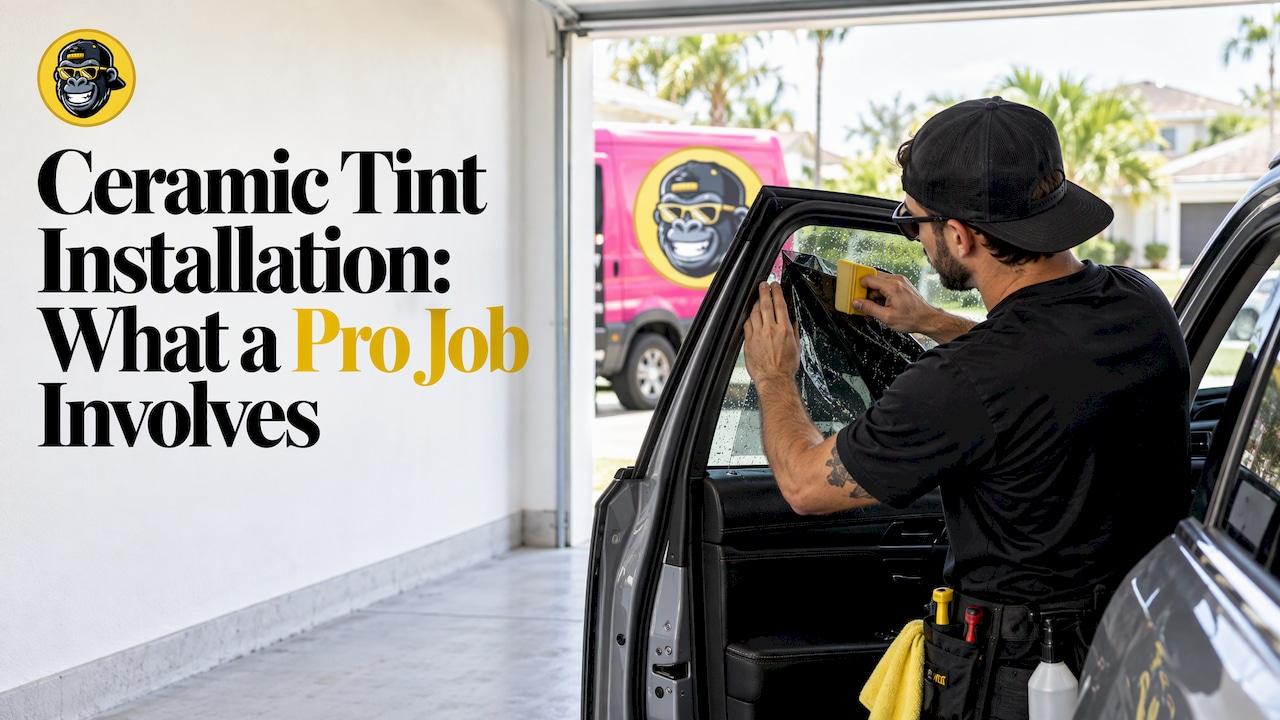
Ceramic tint is only as good as the hands that put it on. The film sets the ceiling for heat and UV rejection, but the installation decides whether you get years of clear, bubble-free glass or edges that lift by year two. If you live in Volusia or Flagler County and want the job done well without losing a day at a shop, Tint Monkeys installs ceramic film at your home, office or driveway from fully equipped mobile units.
This guide walks through how a professional ceramic install is done, where jobs go wrong, what Florida law says about darkness, and how to care for the film afterward.
TL;DR
- Ceramic film is thicker and stiffer than dyed film, so it takes more skill, patience and prep to install cleanly, especially on curved glass and windshields.
- A professional job comes down to five things: clean glass, a controlled workspace, accurate shrinking, precise trimming and a final inspection.
- Car film goes on the inside of the glass. Home and office glass needs architectural film, not automotive film.
- In Florida, front side windows must let in at least 28% of light, so the shade you pick matters as much as the film type.
- Tint Monkeys installs ceramic-only film on location across Volusia and Flagler Counties, with a warranty that includes no-fault coverage.
Table of Contents
- Why installation matters more than the film
- How a professional ceramic install goes, step by step
- Windshields and curved glass take longer
- Inside or outside the glass?
- Is ceramic harder to install than other film?
- Florida darkness rules to settle before you pick a shade
- What mobile installation changes
- Book ceramic tint at your location
- How to judge a finished job
- Caring for tinted windows
- What drives the price of ceramic tint installation
- FAQ
- Sources
Why installation matters more than the film
Two cars can get the same ceramic film and end up with very different results. Bubbles, creases and uneven application are the usual problems when the work is rushed or inexperienced, and AAA notes that ceramic film's advanced composition calls for specialized skills and tools. Installers heat-shrink and mold the film to the contours of the glass to get a smooth, bubble-free finish.
There is a practical reason for that. Ceramic film carries nanoparticles that block heat and UV without needing a dark shade. That construction makes it thicker and less forgiving than basic dyed film, so shrinking it to a curved rear window takes a slower, more deliberate hand. A shortcut that would pass on cheap film shows up as creases or "fingers" (small ridges at the edge of the film) on ceramic.
If you are comparing quotes, you are mostly comparing installers. One professional-tint cost analysis from TintGrade (May 2026) reports that a premium shop with a dust-controlled bay charges $100 to $200 more per job than a bargain shop, and that a very cheap ceramic special is likely to bubble within two years. The gap pays for prep time and a clean environment.
How a professional ceramic install goes, step by step
Here is the sequence a careful installer follows on a vehicle, and what goes wrong at each stage when it is skipped. The method is wet application: film and glass are both wet with a slip solution so the film can be positioned before it bonds. Avery Dennison's Supreme Ceramic data sheet describes its automotive ceramic film as applied to the inside of the glass using the wet method.
1. Inspect the vehicle with you
Before any film is cut, a good installer walks the car with you to note existing damage and checks for any UV or ceramic coating on the glass. The International Window Film Association's automotive guidelines call for both, since scraping over an existing coating or scratch causes damage that gets blamed on the tint later. This is also when you settle the shade and which windows get film.
2. Prepare the workspace
Dust is the enemy of every tint job. A speck trapped under the film becomes a permanent bump, and dirt along the edges is a leading cause of lifting. That is why the workspace matters: shaded, clean, with the car out of wind and falling debris. A mobile installer has to create that controlled space at your location, which is part of the craft. Tint Monkeys' approach centers on meticulous prep and fitment, and on not rushing the job.
3. Clean the glass thoroughly
3M's installation instructions start with cleaning the inside glass by scraping, rinsing and squeegeeing, then cleaning the outside so dirt does not migrate onto the film. Care is needed around rear-defroster lines, antenna traces and printed markings on the glass, where a careless razor blade does lasting damage. Rushing this step is the most common route to contamination under the film.
4. Cut and shape the film
Installers use different methods depending on the glass: straight strip, defroster-cut strip, and heat-shrink (wet or dry) techniques, as the IWFA guidelines list. Flat side windows are simple. A curved rear window is not: the film has to be shaped to the glass first, with even, gradual heat, so it lies flat without tension. Stiff ceramic film punishes uneven heat with creases.

5. Apply and squeegee
With the glass flooded with solution and the adhesive kept wet, the film floats into position. It is aligned fully before any squeegee pass, then pressed out from the center toward the edges with firm, overlapping strokes. Dragging the film dry across the glass creases it. Too much soap in the solution can also slow bonding, and the film can then curl as moisture evaporates before the adhesive sets.
6. Trim, edge and inspect
Precise trimming leaves an even, narrow gap at the edge of the glass. The last step is inspection under direct light and from the side, looking for contamination, fingers, lifted edges, trim quality and optical clarity. This is where you should be standing next to the installer.
Windshields and curved glass take longer
The windshield is one large, deeply curved piece of glass, and TintGrade's analysis says it takes about twice as long to install cleanly as a side window, with near-clear film the hardest to get right. If you want a clear heat-blocking film on the windshield or a visor strip, ask your installer how they handle the curve.
Tint Monkeys lists Pro Ceramic and Select Ceramic film options along with Sides & Rear, Front Two, Windshield and Visor Strip services on its automotive tint page, so you can choose a full-car package or only the windows you need.
Inside or outside the glass?
On vehicles, tint goes on the inside. LLumar's FAQ states that automotive tint is typically applied to interior glass surfaces, which protects the film from car washes, road grit and window wipers.
Home and office glass is a different product category. LLumar discourages using automotive film on non-automotive architectural glass, because its heat absorption can be too high and may cause breakage. Architectural films are made for that glass. Tint Monkeys offers Solar Control, Decorative and Safety & Security films, plus dedicated residential and commercial window tint services. For homeowners weighing film for the AC bill, our home window tint guide for Daytona Beach covers cost, film and rules.

Is ceramic harder to install than other film?
Yes. Ceramic is stiffer than dyed film, takes more heat control to shrink, and gives you less room for error on curves. DIY kits exist for most film types, but AAA's guidance is that a professional-quality finish is hard to achieve for inexperienced installers, with bubbles and creases the common outcome. Add the tools, a clean enclosed workspace and several hours of focused work, and a professional install is the practical route for a vehicle you drive every day.
Florida darkness rules to settle before you pick a shade
Before film goes on, the shade has to be legal. Under Florida Statute 316.2953, front side windows must allow at least 28% of light in, and sunscreening material on them is also limited in how reflective it can be. Rear side and back windows follow separate limits that are more lenient for SUVs, vans and trucks than for sedans, so confirm your vehicle's category when you book. Because ceramic film rejects heat without relying on darkness, a legal shade can still cut a lot of the glare and heat you feel in a Daytona summer.
A medical exemption exists for qualifying conditions, but it runs through the state and needs a physician's sign-off, so speak with your doctor and the Florida Highway Safety and Motor Vehicles department if you think you qualify.
If you are also planning other quick modifications to your car, this overview of quick car mods for beginners points out the legal traps worth knowing before you start.
What mobile installation changes
For busy owners and dealerships, the appeal is simple: the installer comes to you. Tint Monkeys works from fully equipped mobile units at the customer's chosen location in Daytona Beach, Deltona, New Smyrna Beach, DeLand, Port Orange, Ormond Beach, Ormond-by-the-Sea, Palm Coast, Edgewater and across Volusia and Flagler Counties. You schedule a time, and the job happens at your home, office or lot without a drop-off, a ride or a lost day.
For businesses, the same service covers glare reduction on storefronts and offices. Our guides to office window tinting and storefront window tinting explain what to expect. Dealerships can ask about the dealer program on the main site.
Book ceramic tint at your location
Tint Monkeys installs ceramic-only film, with careful prep and fitment and a warranty that includes no-fault coverage. For vehicles, choose the package that fits your car on the automotive page. For a home or business, start with the residential or commercial page. Pricing is quoted per job, so request a quote for your vehicle or glass.

How to judge a finished job
Whether the work is on your car or your living room windows, check it in good light before the installer leaves. Look for these points:
- Clean edges: an even, narrow gap at the glass edge, with no film lifting.
- No contamination: no specks, hairs or lint trapped under the film.
- No fingers or creases: especially on the rear window and any curved areas.
- Clarity: no distortion when you look through the glass from different angles.
- Defroster and antenna lines: intact and undamaged.
Small hazy spots can appear while the film is still drying, and they usually clear as it cures, so ask your installer how long to wait and follow their guidance. That is also why the warranty matters: a no-fault warranty means you have a path to a fix if something shows up later.
Caring for tinted windows
After installation, treat the film gently, and ask your installer for the exact curing time before you roll windows down.
- Wait before cleaning. Leave the film alone during the curing period your installer gives you.
- Skip ammonia. AutoZone's guide warns that ammonia-based glass cleaners can damage tint and recommends soapy water instead.
- Use soft materials. A microfiber cloth and gentle pressure avoid scratching the film's surface.
- Mind the edges. Do not pick at the corners or the edge of the film, and be careful around seat belts and window tracks.
We have more routines for keeping your vehicle looking its best on our auto care page.
What drives the price of ceramic tint installation
Price depends on film grade, how many windows are covered, vehicle size and glass shape, and the care put into prep. As TintGrade's analysis shows, the cheapest quote usually reflects less time spent on cleaning and a less controlled environment. Windshields and heavily curved rear glass cost more because they take longer to do cleanly. For homes and offices, the amount of glass, its type and access all affect the quote. Tint Monkeys does not publish fixed prices, so the way to get a number is to describe your vehicle or property and ask for a quote.
Our view: the film is half the job
We only install ceramic film, because heat, UV and glare are what our customers in Volusia and Flagler Counties are fighting every day, and ceramic is built to reduce all three.
But we have never believed the film alone makes a good result. The preparation does. Clean glass, careful fitment and patience on curved windows are what keep film clear and flat for years, and we do not rush any of it. That is the reason we bring a fully equipped mobile unit to you: the work gets our full attention while your day carries on.
Our warranty includes no-fault coverage, because we want you to feel confident about the work long after we leave your driveway.
Tint
FAQ
Can I install ceramic window tint myself?
Kits are sold, but ceramic film is stiffer and harder to shape than dyed film, and AAA says bubbles, creases and uneven application are common with inexperienced installers. A professional install gets you a clean finish and a warranty. Tint Monkeys handles it at your location.
Is ceramic tint installed inside or outside the glass?
On vehicles it goes on the inside of the glass, which keeps it away from washing and wiper wear. Home and office windows use architectural film made for that glass.
How long does installation take?
It depends on how many windows are covered and how curved they are. A full vehicle with a windshield takes longer than sides and rear only. Tell us your vehicle and we will give you a time estimate when you book.
Is $500 a lot for ceramic tint?
It depends on the vehicle and the scope. Quality ceramic installation is priced for the film plus careful prep and skilled labor, and professional cost analyses show premium shops charging more than bargain ones for that reason. Request a quote for your specific vehicle.
Sources
- 6 Types of Window Tint to Consider for Your Car, AAA
- Ceramic Window Tint Cost by Brand: 2026 Price Breakdown, TintGrade
- Supreme Ceramic Series Product Data Sheet, Avery Dennison
- IWFA Automotive Installation Guidelines
- Automotive Window Tint Frequently Asked Questions, LLumar
- ScotchTint Automotive Window Film Installation Instructions, 3M
- Florida Statutes 316.2953, Florida Senate
- How to Tint Your Own Car Windows, AutoZone