
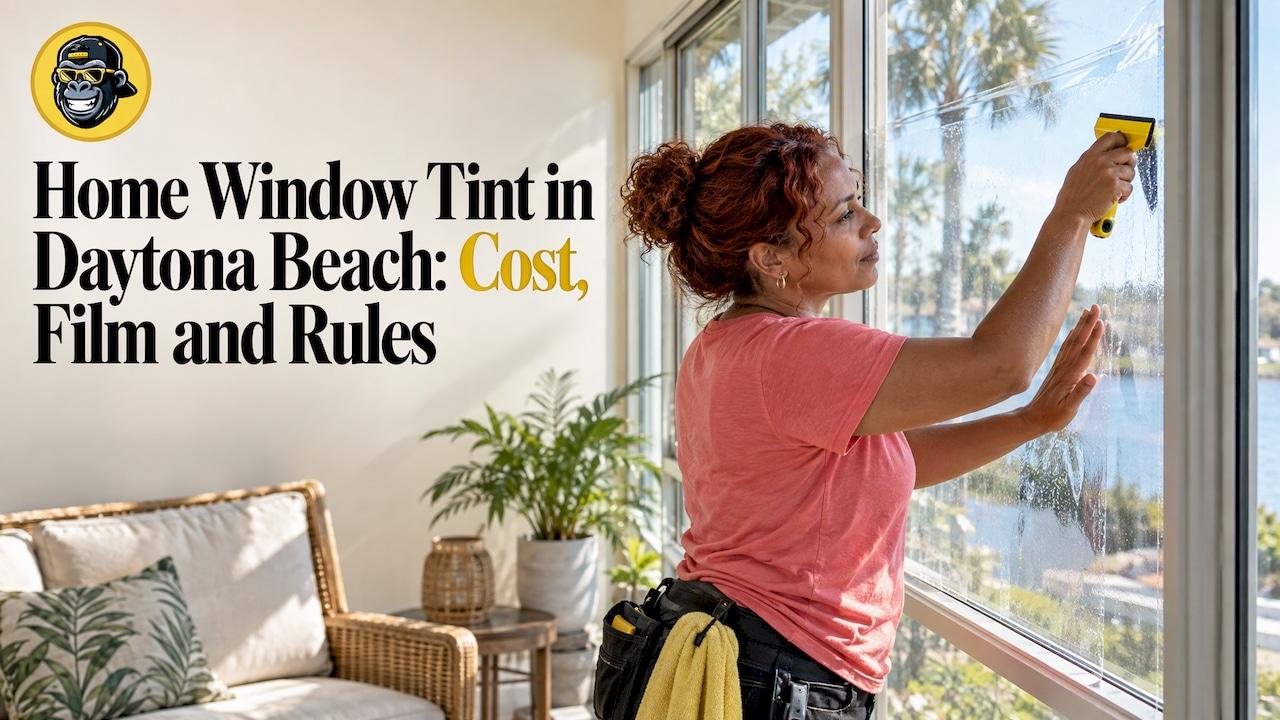
Home window tint in Daytona Beach is a clear film applied to the glass of your windows and doors. It cuts solar heat, blocks most UV and tames glare, so rooms stay cooler and furniture fades more slowly. Pricing depends on how much glass you have, which film you choose and how hard the glass is to reach, so a measured quote beats any online average. At Tint Monkeys we install ceramic film at your home with a fully equipped mobile unit, so you don't have to rearrange your day.
TL;DR
- Quality window film blocks 95 to 99.9% of UV and reduces solar heat gain through the glass, which is the main reason Florida homeowners tint.
- Cost is driven by square footage, film type, pane size and layout, access, and whether old film has to come off. Get a measured quote rather than a guess.
- Near the beach, sea turtle lighting rules can apply. Tint that keeps interior lights from showing on the sand is one of the recommended fixes.
- Window film is not hurricane protection, so keep your shutters or impact-rated protection.
- We tint homes on site across Daytona Beach and Volusia County, usually in a matter of hours.
Table of Contents
- What home window tint does in a Daytona Beach house
- How much does home window tint cost in Daytona Beach?
- Choosing the right film for your windows
- Florida rules and beach-area considerations
- What the installation looks like
- Questions to ask before you hire a tinter
- Our perspective: why we tint homes the way we do
- Get your windows tinted without leaving home
- FAQ
- Sources
What home window tint does in a Daytona Beach house
Daytona Beach gets long, bright summers and a lot of low-angle sun off the Atlantic. Big sliders, west-facing living rooms and sunrooms take the worst of it. Glass lets sunlight in as visible light, UV and infrared heat, and the AC has to remove whatever comes through.
Residential film works on three of those problems at once:
- Heat. Films reduce solar heat gain through windows, according to the Efficient Window Coverings overview of applied film.
- UV. The same source puts UV blocking at 95 to 99.9%. UV is what fades hardwood floors, rugs, art and upholstery, so the film protects what is inside your home as well as your comfort.
- Glare. Less glare means less eye strain on screens and TVs, and you can open blinds you used to keep shut.
The film is thin, typically 2 to 7 mils, and it is built from an adhesive layer, a polyester layer and a scratch-resistant coating, per the same page. That is why a good installation looks like clean glass, not a sticker.
Why ceramic film
Not all films work the same way. Some darker films mostly absorb heat, and the glass then warms up. Spectrally selective films are designed to block parts of the sunlight spectrum that cause heat while letting visible light through. Efficient Window Coverings explains that approach keeps visibility while cutting unwanted solar heat, whereas heavily absorbing films give up some of the comfort and savings.
That is the logic behind our ceramic-only approach. Our ceramic films are designed to reduce heat, UV and glare while keeping the view natural, which suits Florida homes where you still want daylight.

How much does home window tint cost in Daytona Beach?
We don't publish fixed prices for residential tint, and that is deliberate. Two houses with the same square footage can need very different work. These are the factors that move a quote:
| Factor | Why it changes the price |
|---|---|
| Total glass area | Film and labor scale with square footage, so a condo with two sliders costs less than a two-story home. |
| Film type | Solar control, decorative and safety and security films are different products with different material costs. |
| Pane size and layout | Film comes on rolls, so many small panes create more offcut waste and more cutting than a few large ones. |
| Access | Tall stairwell windows, second-story glass and hard-to-reach panes take more time and equipment. |
| Existing film | Old, bubbled or dyed-out film has to be removed and the glass cleaned before new film goes on. |
| Glass condition | Failed seals or damaged frames need attention first, since film cannot fix them. |
| Warranty level | Film backed by a written manufacturer warranty is part of what you pay for. |
A quote built from your actual windows is the only number worth budgeting around. The quickest way to get one is our free quote form. Send the number of windows, a rough size, and which rooms bother you most.
What you get for the money
It helps to think of tint as a long-term fixture. The film stays on the glass for years, so the comparison that matters is cost against years of cooler rooms, less fading and possibly lower cooling use, not against a one-time purchase. Professional-grade film also has certified performance ratings and manufacturer-backed written warranties, as the International Window Film Association notes. A cheap film without those is rarely a bargain.
Choosing the right film for your windows
Start with what bothers you most, then match the film.
Solar control film
This is the film for heat and UV. It is the usual choice for west- and south-facing glass, sliding doors, sunrooms and enclosed lanais. You get a cooler room with the view still intact.
Decorative film
Decorative films add privacy or style to bathrooms, entryways, front-door sidelights or interior glass without blinds. They suit homes close to the street or to neighbors.
Safety and security film
These films hold glass together if it cracks, which helps with break-ins and accidents. One caution matters in Florida: the Pinellas County Construction Licensing Board states that window film does not qualify as approved hurricane protection under the Florida Building Code. Treat security film as an addition to your storm protection, never a replacement.
You can see the full lineup on our architectural films page and our residential window tint page.
Is film right for your windows?
Film works best on windows that are in good shape. Ask whether your windows are suitable for film, since the IWFA advises homeowners to check suitability and expected film life before buying. If a pane has a failed seal, fogging between the layers or a damaged frame, fix that first. When we visit, we look at the glass before we quote so you know the film is a good fit.
Florida rules and beach-area considerations
In most of the home setting, tint is a free choice. No license is required to buy or install window film in Florida, according to the Pinellas County board. But a few things are worth checking before you order.
Sea turtle lighting near the beach
If your home or condo is on or near the beach, interior lights can disorient nesting turtles and hatchlings. The Florida Fish and Wildlife Conservation Commission says that applying tint so interior lights aren't visible from the beach is one of several quick, inexpensive and effective fixes. The FWC recommends tint meeting 45% or less inside-to-outside transmittance on glass, and notes that tints as low as 15% have been used successfully.
If you live oceanfront in Daytona Beach or Ormond-by-the-Sea, ask us about film that meets that guidance. It is also a good reason to tint, since the film does double duty for comfort and wildlife.

Condo and HOA rules
Many Daytona Beach condo declarations spell out what you can do to exterior glass. Some require any replacement glass to be of the same shaded or tinted type that meets Florida DEP turtle-lighting requirements, as one local condominium's documents do. Check your association's rules on exterior appearance and reflectivity, and get written approval before film goes on. Mirror-like films are the ones most likely to raise questions.
What the installation looks like
The installation is the part most people worry about, and it is simpler than it sounds. Professional installation can take only a matter of hours, even though the films themselves are complex products.
- Request a quote. Tell us about your windows and which rooms are the problem.
- Choose the film. We help you match film type and shade to your goals: heat, privacy, security or style.
- We come to you. Our mobile unit arrives with the equipment for the job. You don't drive anywhere or leave your windows with a shop.
- Prep and fit. We clean the glass carefully and measure and cut each piece for a clean fit. Meticulous prep is where tint jobs are won or lost.
- Application and cleanup. The film goes on from inside in most cases, and we leave the area tidy.
- Curing. Fresh film can look slightly hazy or have tiny moisture pockets for a short time while it dries. Hold off on cleaning the glass until we tell you it is ready, and avoid scraping the film.
After that, care is easy: use a soft cloth and a non-abrasive, ammonia-free glass cleaner.
Questions to ask before you hire a tinter
The IWFA suggests asking whether the dealer has recent-work references, trade association membership and accreditations. Good additional questions:
- Which film exactly will go on my glass, and what warranty comes with it?
- Who stands behind the installation if something goes wrong later?
- Will you look at my windows first to see if they suit film?
- How do you prepare the glass, and how do you handle edges?
- Do you come to the house, and how long will the work take?
Our answers: ceramic-only film, a comprehensive warranty that includes no-fault coverage, and installers who don't rush jobs.
Our perspective: why we tint homes the way we do
We started Tint Monkeys because tint shouldn't cost you a day off. A mobile shop means your windows get treated where they live, with good light, plenty of time and no pressure to hurry.
We use ceramic film only. In a Daytona Beach house, the goal is a room that feels cooler and less harsh without turning into a cave. Ceramic films are designed to do that: cut heat, UV and glare while keeping daylight and the view.
The film is half the job. The other half is prep and fitment, and that is where we spend our time. Clean glass, careful cuts and patient application are what you notice years later.
We back the work with a comprehensive warranty that includes no-fault coverage, and we'd rather answer your questions before the job than after it.
Tint
Get your windows tinted without leaving home
We bring ceramic window film to homes in Daytona Beach, Port Orange, Ormond Beach, New Smyrna Beach, DeLand, Deltona, Edgewater, Palm Coast and across Volusia and Flagler counties. Whether it is a sunny slider, a bedroom that never cools down or a front door that needs privacy, we will look at your glass and recommend the film that fits.

See our residential window tint services or request your free quote to book a visit. Business owners can look at our commercial window tint options.
FAQ
Does home window tint really lower my AC bill?
It can help. Film reduces the solar heat that enters through glass, so the AC has less to remove, which is most noticeable in rooms with large west- or south-facing windows. Actual savings depend on your windows, your home and how you use cooling, so we don't promise a specific number.
Can window film go on double-pane windows?
Often yes, when the windows are in good condition. The IWFA recommends asking whether your particular windows are suitable for film. We check your glass during the quote, and we will tell you if a pane has a problem that needs fixing first.
Will tint protect my home during a hurricane?
No. Window film does not count as approved hurricane protection under the Florida Building Code. Keep your shutters or impact-rated glass in place. Security film can add strength against everyday breakage, but storm protection is a separate system.
How long does a home tint installation take?
Professional installation is usually a matter of hours, depending on how many windows you have, their size and access. We confirm the timing when we quote, and the film then cures over a short period.
Do I need a permit or license for window tint in Florida?
No license is required to buy or install film in Florida, per the Pinellas County Construction Licensing Board. If you live in a condo or HOA community, though, get written approval first, and if you are near the beach, keep sea turtle lighting guidance in mind.
Sources
- Applied Film, Efficient Window Coverings
- Before You Buy Window Film, International Window Film Association
- Sea Turtles and Lights, Florida Fish and Wildlife Conservation Commission
- Window film guidance, Pinellas County Construction Licensing Board
- Condo documents, Bella Vista Condominiums, Daytona Beach