
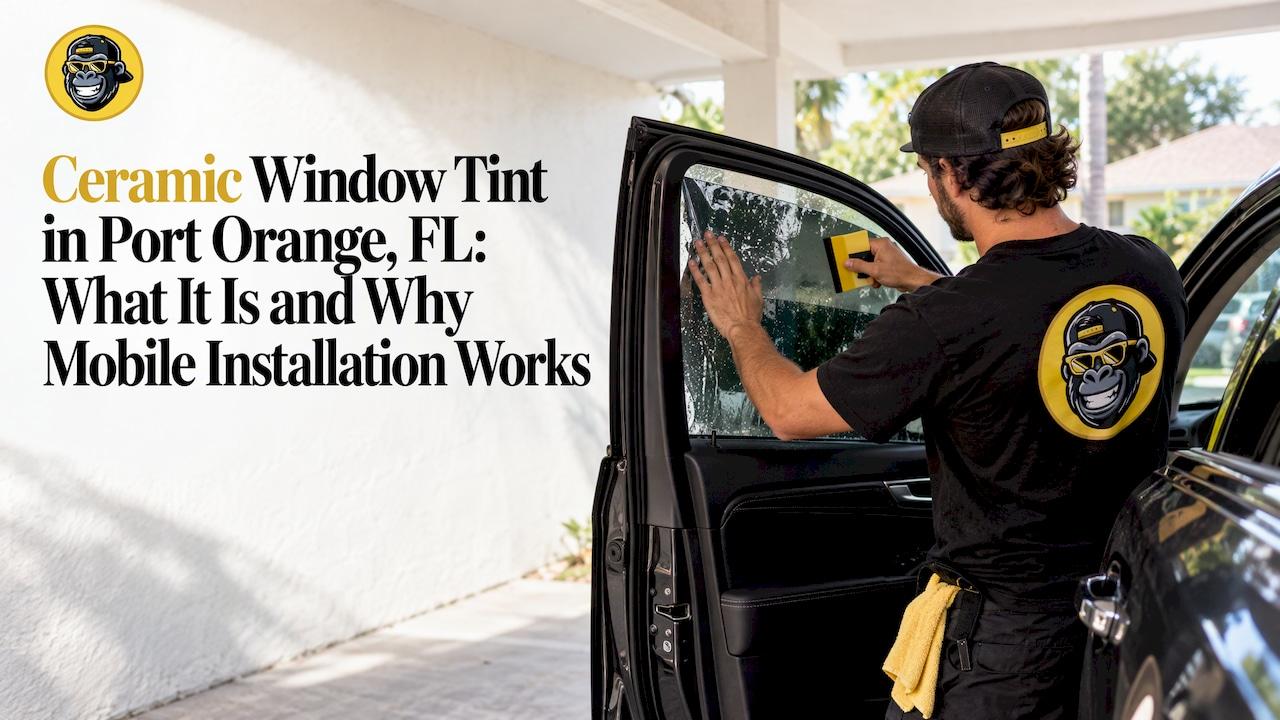
Ceramic window tint is the film to choose in Port Orange if your goal is a cooler cabin, less glare and UV protection without going darker than Florida law allows. We install it at your home, office or dealership lot, so you don't give up half a day at a shop. Tint Monkeys works only with ceramic film, serves Volusia and Flagler counties, and is based at 4719 S Ridgewood Ave in Port Orange.
This guide covers what ceramic tint is, how it differs from dyed film, the Florida rules you need to know, what a clean installation looks like, and how ceramic film also works on houses and storefronts.
TL;DR
- Ceramic film uses microscopic ceramic particles to block infrared heat and UV, so a lighter, legal shade can still keep the car noticeably cooler.
- Florida requires front side windows to let in at least 28% of visible light, so choose your shade with the law in mind.
- Installation quality (prep, fitment, clean edges) decides how the film looks and lasts as much as the film does.
- Mobile installation puts a trained installer at your driveway, workplace or lot in Volusia and Flagler counties.
- The same ceramic and solar-control technology is available for homes and businesses, where it targets AC costs and glare.
Table of Contents
- What ceramic window tint actually is
- Why Port Orange drivers feel the difference
- Florida tint rules: pick a shade that stays legal
- What a good installation looks like
- Mobile installation: tint without the shop trip
- What ceramic tint costs
- Beyond the car: homes and businesses
- Book ceramic tint at your door
- Our perspective
- Frequently asked questions
- Sources
What ceramic window tint actually is
Ceramic tint is a multilayer film infused with microscopic, nonconductive ceramic particles. Consumer Reports describes it as blocking a very high share of ultraviolet rays (manufacturers claim 99.9%), and notes that the labor to install it is the same as for non-ceramic film. The film itself is what costs more.
The key difference from cheaper film is how it handles the sun. Dyed film mostly absorbs solar energy and turns it into heat inside the film. Ceramic film's inorganic particles reflect and scatter infrared wavelengths while staying transparent to visible light. That is why ceramic film can reject more total solar energy at the same darkness.
Two more practical points:
- Clarity. Because the particles are smaller than the wavelength of visible light, ceramic film shows minimal color distortion and less haze than dyed film at comparable darkness, which helps with night visibility.
- Signals. Ceramic film is nonmetallic, so it is designed not to interfere with cell, GPS or radio signals, a point film makers state on their product pages.
Why Port Orange drivers feel the difference
A parked car in Port Orange in July is an oven. Glass lets in visible light, infrared (the part you feel as heat) and UV (the part that fades dashboards and seats). Ceramic film targets the last two.
Manufacturer figures give a sense of range. One nano-ceramic line lists up to 94.59% infrared blocked, 99% UV blocked and total solar energy rejected (TSER) up to 64%. Another lists up to 86% IR, 99% UVA/UVB and TSER up to 66%. Results vary by product and shade, so read TSER as the number that best describes real heat reduction, and VLT (visible light transmission, the percentage of light that passes through) as the number that describes darkness.

A Consumer Reports technician puts the benefit this way: "You can have a lighter tint that still offers superior protection." For a driver who needs to stay inside Florida's limits, that is the whole appeal: heat performance comes from the film technology, not from how dark the glass looks.
Heat, UV, glare and fading
- Heat: The cabin heats more slowly and the AC has less to fight when you start the car.
- UV: Less UV reaches your skin through the glass and your interior. Consumer Reports notes that ceramic film slows interior fading.
- Glare: Lower glare on bright, low-sun commutes on Dunlawton Avenue or I-95 means less squinting.
- Privacy and style: A consistent, color-stable shade gives the vehicle a finished look and keeps belongings less visible.
If privacy for the back of an SUV is a priority, these SUV rear privacy options are worth reading alongside your shade decision.
Florida tint rules: pick a shade that stays legal
Florida sets limits by window position. Under Florida Statute 316.2953, side windows beside or forward of the driver must allow at least 28% of visible light through and may not exceed 25% total solar reflectance. The measurement is taken on the glass of your specific vehicle. A violation is a noncriminal traffic infraction under chapter 318.
There are a few things people often miss:
- Factory glass is already tinted. Most vehicles have some built-in tint, so the film you add is layered over it. The final reading is what counts, not the number printed on the film box.
- Rear windows have their own limits. They differ between sedans and SUVs or vans, so confirm your vehicle type before choosing the back shade.
- Reflective finishes have caps. Mirror-like films run into the reflectance limit quickly. Ceramic film gets its performance from particles, not a mirrored surface, which is one reason it suits Florida.
We help you choose a shade for each window before the film goes on, so you aren't guessing at the driveway. If you have a medical reason for darker glass, Florida has an exemption process handled through the state, and your doctor is the person to start with.
What a good installation looks like
Film is only half of a good result. The other half is the installer, and the details are easy to see once you know them. Window Film Depot advises that buyers in hot regions like the Southeast should prioritize high TSER and IR rejection, and use an experienced, insured installer, because DIY application risks voiding warranties and poor performance.
Here is the routine, step by step, and what we do at each stage.
1. Choose the film and shade
Pick the film grade, then a shade for each window. We offer Pro Ceramic and Select Ceramic on our automotive page, and we only work with ceramic film. Packages include Sides & Rear, Front Two, a Windshield option and a Visor Strip, so you can tint the whole car or just the windows you need.
2. Prepare the glass
Dust, lint and pet hair under the film become bubbles and specks you see forever. Preparation is where rushed jobs go wrong. We do meticulous prep and don't rush jobs, and our mobile units are fully equipped, so the work happens at your location.
3. Cut and fit the film
The film has to follow the curve of the glass and finish with an even edge. Careful fitment is what makes the tint look factory-installed instead of stuck on. For a deeper look, read our guide to what a pro ceramic tint job involves.
4. Cure and care
Fresh film needs time to settle. We walk you through aftercare so you don't roll windows down or clean the glass too early, and that protects your result and your warranty.
5. Warranty
Our warranty is comprehensive and includes no-fault coverage. When you book, ask us to walk you through exactly how it applies to your vehicle.
Mobile installation: tint without the shop trip
The hardest part of window tinting is usually the logistics. A shop visit means dropping the car off, finding a ride and losing hours. Our approach removes that. We come to the address you choose, whether it is a driveway in Port Orange, a parking lot in Daytona Beach, an office in Ormond Beach or a lot in Deltona, and you carry on with your day.
This is particularly useful for:
- Busy professionals and parents who can't leave work or home.
- Dealerships and fleets that need several vehicles done without moving them. See our dealer program and fleet service.
- Owners of new or high-value vehicles who prefer the work done at a place they control.
We serve Port Orange, Daytona Beach, Deltona, New Smyrna Beach, DeLand, Ormond Beach, Edgewater and Palm Coast. Local pages cover Daytona Beach, Palm Coast, DeLand and Deltona.
What ceramic tint costs
Ceramic film costs more than dyed film. Consumer Reports reports that the labor is the same as for non-ceramic film and that the premium is several hundred dollars. The final price for your vehicle depends on:
- Number of windows: a Front Two job is smaller than a full Sides & Rear package.
- Film grade: Pro Ceramic or Select Ceramic.
- Vehicle size and glass shape: a large SUV or a vehicle with steeply curved glass takes more film and more time.
- Extras: windshield film or a visor strip.
- Old film removal: if there is old film on the glass, it has to come off first.
We quote by vehicle and window selection, so you get a figure for your car rather than a range.
Beyond the car: homes and businesses
The same principle works on buildings. West-facing glass in a Port Orange house can load the AC on summer afternoons, and storefront glare can make screens unusable and customers squint.
- Homeowners: Residential window tint targets heat, UV that fades floors and furniture, and the AC bill. Our architectural films include Solar Control Films, Decorative Films for privacy and style, and Safety & Security Films.
- Businesses: Commercial window tint reduces glare and heat for offices, shops and other properties, and we install on site.
The film choice for a building differs from a car, because building glass has different thermal behavior, so we match the film to the window rather than reusing the automotive spec.
Book ceramic tint at your door
If you are in Port Orange, you can book with Tint Monkeys and have a trained installer apply premium ceramic film at your home, work or lot. Start with the automotive tint packages, or go to the Tint Monkeys homepage to request a time. Tell us your vehicle, the windows you want done and where you'll be, and we'll plan the visit around you.

For larger jobs, such as several cars or a whole building, a visit to the pro installation page explains how we work.
Our perspective
We built Tint Monkeys around one idea: good tint shouldn't cost you a day. The film matters, and we use ceramic only, because it delivers heat and UV performance without pushing you toward a dark shade that Florida law doesn't allow.
But film is only as good as the hands that install it. We put our effort into prep and fitment, and we don't rush a job to fit the next appointment. Our mobile units are fully equipped, so the quality you'd expect in a shop comes to your driveway.
We also stand behind the work. Our warranty is comprehensive and includes no-fault coverage, because a tint job should be something you can forget about, not something you worry over.
For Port Orange drivers, homeowners and business owners, that is the whole case: premium ceramic film, clean installation, and service at the place that suits you.
Tint
Frequently asked questions
Is ceramic tint worth it in Florida?
For most drivers here, yes. Ceramic film is built to reject infrared heat and UV, which is exactly what Florida sun delivers. Because the heat reduction comes from the film technology, you can stay at a legal, lighter shade and still get a cooler cabin.
How dark can I legally tint my front windows in Florida?
Front side windows must let in at least 28% of visible light, and total solar reflectance may not exceed 25%, according to Florida Statute 316.2953. The reading is taken on your vehicle's glass, including any factory tint. We help you pick a shade that complies.
Will ceramic tint interfere with my phone or GPS?
No. Ceramic film is nonmetallic and is designed not to interfere with cell, GPS or radio signals, as film manufacturers state. This is one of the reasons many drivers choose it over metallic film.
Can you tint my car at home or work?
Yes. We come to the location you choose in Volusia and Flagler counties with a fully equipped mobile unit. Choose a spot with room around the vehicle, and we handle the rest.
Do you tint houses and offices too?
Yes. We install solar control, decorative and safety films on homes and commercial properties, with the aim of cutting heat, UV and glare. See our residential and commercial pages.
Sources
- Is Ceramic Car Window Tinting Worth the Extra Cost? (Consumer Reports)
- Ceramic vs Dyed Window Tinting Film (Astrace Films)
- NEX+ Graphene Infused Ceramic Tint (STEK USA)
- Nano Ceramic Window Films (Pure Tint)
- Understanding Ceramic Window Tint (Window Film Depot)
- Florida Statutes, Chapter 316, Section 316.2953 (The Florida Senate)