
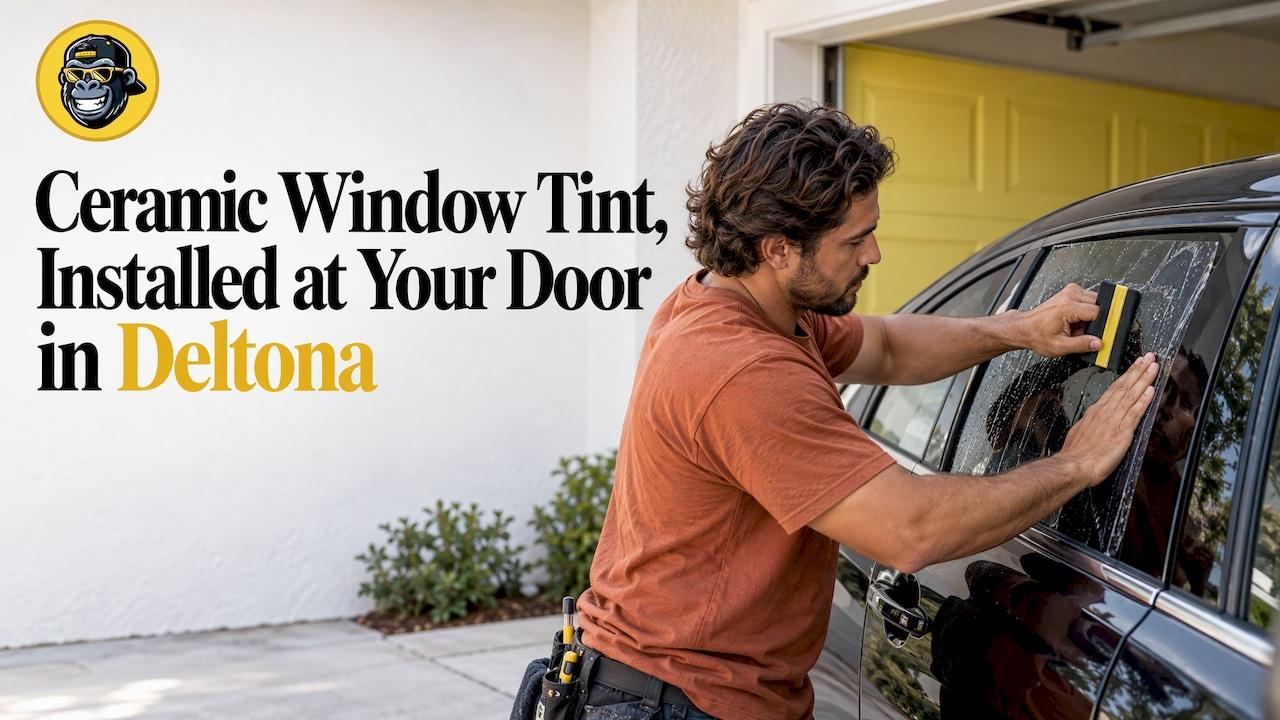
Ceramic window tint is the film to choose in Deltona if you want less heat, less glare and strong UV protection without making your glass very dark. Tint Monkeys installs ceramic-only film at your driveway, office or lot with fully equipped mobile units across Volusia and Flagler Counties, so you never have to give up a day at a shop.
This guide covers how ceramic film works, what it does for a car, a house and a storefront, what Florida law allows on vehicles, and what a mobile installation looks like from booking to care.
TL;DR
- Ceramic film is built to block heat and UV, not just to darken glass, so you can stay within Florida's legal shades and still feel a difference.
- Cars, homes and commercial buildings all benefit: a cooler cabin, lower glare, and for homeowners, less work for the AC.
- Florida sets minimum visible light limits for vehicle windows: 28% on the front sides, 15% or 6% on the back depending on vehicle type.
- Tint Monkeys uses ceramic-only film, comes to your location in Deltona and the surrounding area, and backs the work with a warranty that includes no-fault coverage.
- Quotes are free and depend on your vehicle or building, so request one instead of guessing at a number.
Table of Contents
- What ceramic window tint actually is
- Why Deltona drivers feel the difference
- Ceramic tint for your car
- Ceramic tint for your home
- Ceramic tint for businesses and dealerships
- What Florida law allows on your vehicle
- How a mobile ceramic tint installation works
- Caring for new ceramic tint
- Is ceramic worth it over cheaper film?
- Book ceramic tint where you are
- Our perspective
- FAQ
- Sources
What ceramic window tint actually is
Window film comes in a few types: dyed, metallic, carbon and ceramic. Dyed film is mostly color, so it darkens the glass but does little against heat. Ceramic film uses microscopic ceramic particles instead. One manufacturer describes its ceramic series as built on nanometer-scale titanium nitride, an extremely hard ceramic material, coated onto polyester film in a clean room so color and performance stay consistent.

What that means for you is simple. The ceramic layer is designed to filter out the infrared part of sunlight, which is the part you feel as heat, and to block ultraviolet rays, which fade upholstery and damage skin. It does this without needing a very dark look. A light ceramic film can feel cooler than a darker dyed film, which matters in a state with legal limits on how dark a car's windows can be.
Ceramic film also does not contain metal, so it does not get in the way of cell phones, GPS or radio signals. It tends to hold its color and resist bubbling and discoloring longer than basic film. That is why we install ceramic and nothing else.
Why Deltona drivers feel the difference
Deltona sits in central Florida, where summer sun is intense and a parked car turns into an oven by afternoon. Sunlight comes through your glass as visible light, UV and infrared. Ceramic film goes after the last two.
A 2022 peer-reviewed review in the journal Applied Sciences found that modern ceramic window films block up to 99% of UV radiation and effectively reduce glare and solar gains. The same review points to a study in Lisbon where solar control films raised the share of working hours spent within thermal comfort by 25% compared with plain clear glass. Lisbon is not Deltona, but the physics of cutting solar gain through glass is the same.
In daily life this shows up in a few ways:
- A cooler cabin on a hot day. The seats and steering wheel are less punishing when you get back in, and the AC reaches a comfortable temperature faster.
- Less squinting. Glare off the road, windshields ahead of you and wet pavement is softened.
- Protection for the interior. Less UV reaching the dash and seats means less fading and cracking over the years.
- Privacy. Even a legal shade keeps casual eyes off what you leave in the back seat.
Ceramic tint for your car
For vehicles we offer ceramic packages on our automotive tint page: Pro Ceramic and Select Ceramic for full coverage, plus individual options like Sides & Rear, Front Two, Windshield and Visor Strip. That lets you tint the whole car or start with the windows that matter most to you.
A few ways to decide:
- Commuter on I-4 or Howland Blvd every day: the front side windows and the windshield are where sun hits you directly, so Front Two and Windshield options are worth a look.
- Family SUV or minivan: rear and side windows protect kids in the back seat from hours of direct sun, which is where Sides & Rear fits.
- Anyone who wants a finished look: a full set keeps every window matching, which looks cleaner and cools the whole cabin evenly.
Pricing depends on the vehicle, the number of windows and the film you choose, and we do not publish a flat number because a two-door coupe and a three-row SUV are different jobs. A free quote gives you the real figure for your car.
Ceramic tint for your home
If your living room faces west and the AC runs all afternoon, window film is one of the more direct ways to deal with it. Heat enters a house mostly through glass, and film that rejects solar heat reduces how much the system has to fight. The Applied Sciences review above reports that solar control films cut solar gains and help keep indoor spaces in a comfortable range.
Our residential window tint and architectural films cover three needs:
- Solar Control Films to reduce heat, glare and UV on sun-facing windows.
- Decorative Films for privacy in bathrooms, entryways and glass doors.
- Safety & Security Films to add a layer to glass.
The benefit goes beyond the energy bill. Furniture, floors and artwork fade when UV pours through glass day after day, and film blocks most of that. Rooms that were too bright to use in the afternoon become comfortable again.
Ceramic tint for businesses and dealerships
A storefront or office with large windows has two problems: heat and glare. Glare on computer screens and point-of-sale displays tires staff, and heat makes customers leave sooner. Our commercial window tint brings the same ceramic approach to offices, shops and other commercial properties, and we come to you, so work does not require closing for a day at a remote shop.
If you run several vehicles, our fleet service keeps the whole group consistent, and dealerships can look at our dealer program for professional tinting on inventory without moving cars to an outside shop.
What Florida law allows on your vehicle
Before you pick a shade for a car, know the limits. Florida measures tint by visible light transmission (VLT), the percentage of visible light that passes through the glass and film together. A higher number means lighter tint.
According to a summary of Florida's window tint rules:
| Window | Minimum VLT |
|---|---|
| Front side windows | 28% |
| Back side windows, sedans | 15% |
| Back side windows, SUVs and vans | 6% |
| Rear window, sedans | 15% |
| Rear window, SUVs and vans | 6% |
A transparent strip is also permitted along the top of the windshield, above the AS-1 line marked on the glass. Factory tint that meets federal standards is exempt from the state's sunscreening requirements, and the reading you must meet includes the glass as it came from the factory, which is why a film applied over already-tinted glass ends up darker than the label.
Florida also lets the state issue medical exemption certificates to people with lupus or another condition that requires limited light exposure. If that applies to you, talk to your doctor and the state's motor vehicle agency about the certificate before you choose a darker film.
To see what each percentage looks like on a car, use our tint percentage chart, and our Florida tint law page lays out what to keep in mind when choosing. Because ceramic does its work through heat rejection and not darkness, a legal shade still gives you a real comfort gain.

How a mobile ceramic tint installation works
Here is the routine from first call to finished glass, and what to watch for at each step.
- Request a quote. Tell us the vehicle (year, make, model) or the type of building, which windows you want covered and your city. In Deltona, DeLand, Port Orange, Ormond Beach, Palm Coast and the rest of our area, we come to you. The quote form takes a couple of minutes.
- Choose the film and shade. For cars, this is where you pick between the ceramic packages and settle on a shade that stays inside Florida's limits. We help you match the shade to what you want: more privacy, more heat rejection or a subtle look.
- Pick a place and time. Our mobile units are fully equipped, so a driveway, a workplace parking space or a dealership lot works. You keep your schedule while the work happens. Park in a shaded or covered spot if you can, and keep the car clean on the inside.
- Prep. Clean glass is the foundation of a clean install. Dust, dirt and residue trapped under film show up as specks forever, so meticulous prep and fitment are where we put our attention, and we do not rush the job.
- Installation. The film is cut and fitted to each window and applied by a trained installer.
- Walk-around and warranty. You look over the finished windows with us, and your work is covered by our warranty, which includes no-fault coverage.
The common ways this goes wrong are rushed prep, poorly fitted edges and film that was never meant to last in Florida sun. That is why prep, fitment and film choice get the most attention in our process.
Caring for new ceramic tint
New tint needs a short settling period, and a few habits keep it looking right for years.
- Leave the windows up for a few days. Film needs time to cure against the glass. Your installer will tell you how long for your specific film and vehicle.
- Expect a hazy look at first. Small moisture pockets can show right after installation and clear as the film cures. Do not press on them or pick at them.
- Use soft cloths and ammonia-free cleaner. Ammonia and abrasive towels can damage film over time. A microfiber towel and a gentle glass cleaner are enough.
- Mind the edges. Be careful with seat belts, bags and anything that can catch the edge of the glass when you roll windows down after the curing period.
- Keep your paperwork. Your warranty details are easier to use if you have your invoice.
For homes and offices, the same logic applies: use a soft cloth and a non-abrasive cleaner, and avoid scrapers or razor blades on the film side.
Is ceramic worth it over cheaper film?
Ceramic costs more up front than basic dyed film, and that is where the value argument starts. Dyed film is mostly color and tends to fade and bubble sooner, while ceramic is made to keep its color and its performance. You pay once for work that is meant to last, instead of paying again to remove and replace aging film. Add the comfort in the car every single summer day and, for a house, the lighter load on the AC, and the choice is clear for most Deltona buyers.
Book ceramic tint where you are
We bring the shop to you. Tint Monkeys installs ceramic films on vehicles, homes and commercial properties across Volusia and Flagler Counties, including Deltona, with ceramic-only film, careful prep and a warranty with no-fault coverage. See the automotive packages or ask for a free quote and tell us where you want us to park.

If you also want a look at how we work nearby, our Daytona Beach mobile tinting page and DeLand automotive page show the same service in other parts of the county.
Our perspective
We built Tint Monkeys around a simple idea: good tint should not cost you half a day. Most people put off tinting because it means dropping the car at a shop, finding a ride and hoping the work is clean. We take the equipment to your driveway or parking lot, so the only thing you give up is a little time while we work.
We install ceramic film only. In Florida, heat and UV are the problem, and ceramic is the film designed to solve them, which is why we do not build our business around anything else. The film matters, but so does what happens before it goes on the glass. Careful prep and fitment is where a clean installation comes from, and we do not rush jobs to fit in one more car.
We also stand behind the work with a comprehensive warranty that includes no-fault coverage, because you should not have to wonder what happens after we drive away.
Whether it is a daily driver in Deltona, a house with a west-facing living room, a storefront fighting glare or a dealership lot, our approach is the same: premium film, a clean install, at your location.
Tint
FAQ
Is ceramic window tint worth it in Deltona?
For most people, yes. Ceramic film is designed to cut heat, UV and glare without needing a very dark shade, which suits Florida's sun and its legal limits. Research on solar control films also reports high UV blocking and reduced solar gain.
Does ceramic tint work on house windows too?
Yes. Solar control films reduce heat, glare and UV on sun-facing glass, which makes rooms more comfortable and eases the load on your AC. We offer residential, decorative and safety films for homes through our architectural page.
How dark can I legally tint my car in Florida?
Front side windows must let in at least 28% of visible light. Back side and rear windows must allow at least 15% on sedans and 6% on SUVs and vans, per this Florida tint rules summary. Our tint law page can help you pick a shade.
Can you tint my car at my house or workplace in Deltona?
Yes. Our mobile units come to the location you choose in Deltona and across Volusia and Flagler Counties. Pick a spot with room around the vehicle and request a quote to set a time.
How much does ceramic tint cost?
It depends on the vehicle or building, how many windows you want tinted and which film you choose. We do not publish flat prices, so the fastest way to get your number is the free quote form.
Sources
- What Is Ceramic Window Film? (Concord Window Film)
- Performance of Solar Control Films on Building Glazing (Applied Sciences, MDPI, 2022)
- Ceramic Vs. Regular Tint (AutoZone)
- Florida Window Tint Laws (2026)
- Florida Statutes 316.2957
- Florida Statutes 316.29545