
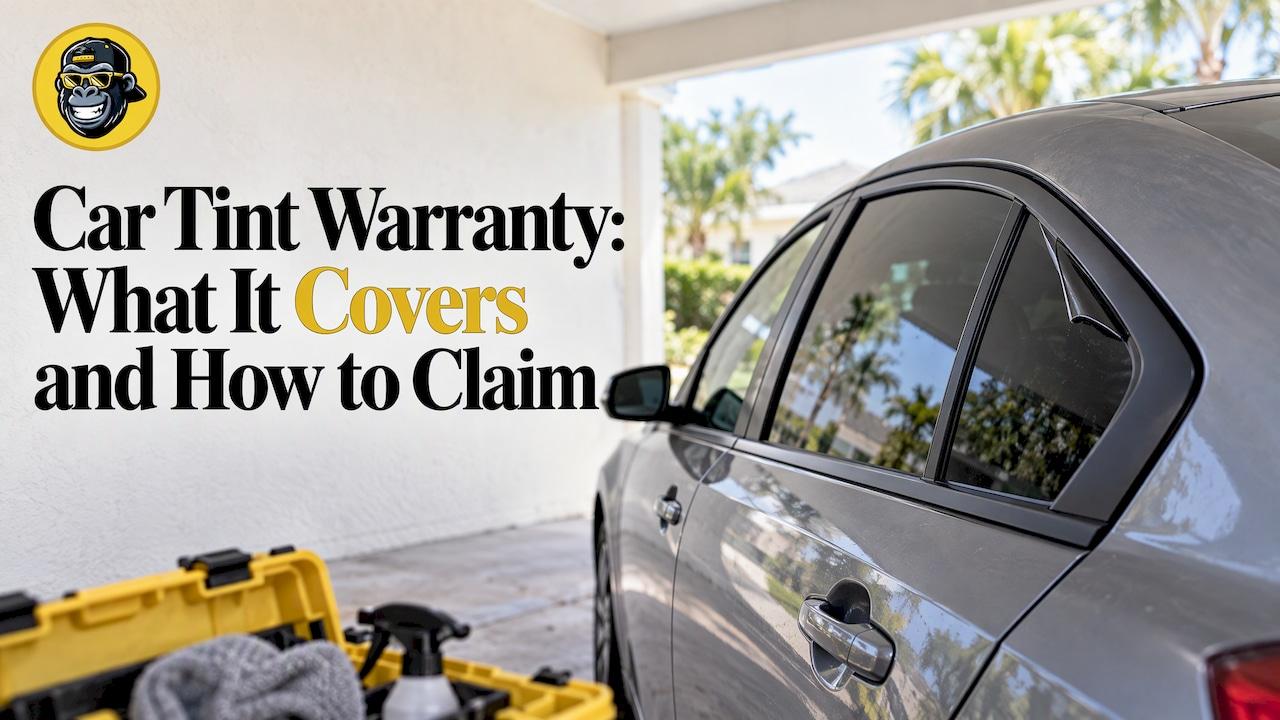
A car tint warranty is really two promises: the film manufacturer guarantees the film, and the installer guarantees the work. The paper that matters most is the installer's, because the installer is the one who handles your claim. At Tint Monkeys we install ceramic film only, and our warranty includes no-fault coverage, so you are not left arguing over whose fault a problem was.
TL;DR
- A tint warranty usually combines a manufacturer warranty on the film (bubbling, peeling, cracking, fading) with an installer warranty on the labor.
- Manufacturer warranties generally require professional installation, the original receipt and registration, and often stay with the original owner.
- "Lifetime" rarely means forever for anyone: it commonly means as long as you own the vehicle. Ask for the terms in writing.
- Illegal tint, DIY work, harsh cleaners and later changes to the film are common reasons a claim gets denied.
- Pick an installer whose warranty you can read before the job and who will still be around to honor it.
Table of Contents
- The two warranties behind every tint job
- What a car tint warranty typically covers
- What "lifetime" actually means
- What can void it or get a claim denied
- How to register and claim, step by step
- Does tint affect your car's factory glass warranty?
- What a good installer warranty looks like
- Why mobile installation helps with warranty
- Book tint that comes with a warranty you can understand
- Our view: the warranty is part of the install
- FAQ
- Sources
The two warranties behind every tint job
When a shop says your tint is "warrantied," ask which warranty it means. There are two, and they cover different things.
The manufacturer warranty covers the film itself. If the film turns purple, bubbles, peels or cracks because it was made badly, the maker stands behind it. 3M's automotive window film warranty card is a typical example: if the film is found defective, the seller replaces it and provides the reapplication labor free of charge during the warranty period. That warranty goes only to the original consumer and cannot be transferred.
The installer warranty covers the work: edges that lift, dust or contamination trapped under the film, poor fit around curves, gaps at the glass edge. A film can be perfect and still fail because it was cut or applied badly. Manufacturer warranties generally assume a professional installation, so a good installer warranty fills the gap between "the film is fine" and "my window looks wrong."

The two meet at one point: you. When something goes wrong you do not want to be the referee between a film maker and a shop. That is why the way a shop handles claims matters as much as the length of the warranty on the paperwork.
What a car tint warranty typically covers
Manufacturer warranties list the failures they cover. Read these as the signs your film may qualify for a claim:
- Bubbling or blistering, where the adhesive has let go of the glass in patches.
- Peeling or lifting, usually starting at the edges.
- Cracking or crazing, a web of fine lines across the film.
- Fading or color change, most often a shift toward purple.
- Delamination, where the layers of the film separate.
Warranty length varies by film line. One manufacturer, VTEK, lists its Solar Armor warranty as 5 years for its CORE line, 10 years for VUE and 15 years for APEX, covering manufacturing defects such as bubbling, cracking, peeling and fading when the film is professionally installed by an authorized installer. The lesson is not the specific numbers. Warranty length follows the film grade, and it only applies if the installation meets the manufacturer's conditions.
Because our work is ceramic-only, premium film, we are not mixing basic dyed films with high-end ones. For you that means one standard of film and one set of expectations across the whole vehicle. Our automotive tint options include Pro Ceramic and Select Ceramic, plus packages such as Sides & Rear, Front Two, Windshield and Visor Strip.

What "lifetime" actually means
The word "lifetime" sells a lot of tint. The first question is whose lifetime. Many lifetime warranties last for as long as the original owner keeps the vehicle. They end when you sell it, trade it in or transfer the title. Some manufacturers allow transfer to a later owner under conditions, such as keeping the original warranty card with the vehicle, but that is the exception and has to be spelled out.
So before you pay, check these points:
- Whose lifetime? The film's, the vehicle's or yours as the original owner.
- Transferable or not? This matters if you lease, trade often or plan to sell privately.
- What is covered? Film only, or film plus labor to remove and replace it.
- Who honors it? The shop that did the work, or a national network.
A warranty is only as strong as the business behind it. A national brand name on the film helps, but when a claim comes up, you will usually start with the installer. That is how 3M describes its claim process: the owner first contacts the installer, and only if the installer is unavailable calls 3M at 1-866-499-8857. The owner presents the warranty card with the original invoice to get service.
What can void it or get a claim denied
Nearly every warranty has an exclusions list. The details differ by brand, so read your own paperwork, but the same categories show up again and again:
- Installation by someone other than an approved professional, including do-it-yourself kits.
- Damage from cleaning products and tools. Abrasive cleaners, ammonia-based glass cleaners, solvents and ice scrapers are the usual culprits.
- Physical damage. Scratches, accidents, a cracked window and glass replacement are normally outside a film warranty.
- Changes after installation. Film that has been removed, reinstalled or altered later is typically no longer covered.
- Illegal tint. One major brand's warranty states that tint installed illegally is not covered for any reason and that the owner is responsible for following state law if the registration location changes.
- Missing proof. No receipt, no registration, no claim.
That last pair deserves attention in Florida. Darkness limits are set by state law, so a film that is too dark can cost you a citation and a warranty at the same time. Our Florida tint law page explains the limits for each window, so you can choose a shade that is legal and still gives you the privacy and heat reduction you want.
How to register and claim, step by step
Here is the routine, and where it usually goes wrong.
Before the job
Ask for the warranty terms in writing before you book. A verbal "it's covered for life" is hard to enforce a few years later. You want to see which film is going on, how long the film is covered, what the installer covers, and whether the warranty transfers.
At the install
Get three things: an itemized invoice with the film name and date, the warranty card or registration confirmation, and the list of windows done. Some manufacturers require online registration within a set period. For example, XPEL's warranty information says proof of installation from an authorized installer is required to process a claim. Missing a registration window is one of the easiest ways to lose coverage, so register the same day.
This is a step we take off your plate when we come to you. Because we work from fully equipped mobile units at your home, office or workplace, the job and the paperwork happen in one visit, and you do not have to chase a counter at a shop.
After the job
Film needs time to cure. Follow the installer's aftercare instructions on when to roll windows down and how to clean. Use a soft microfiber cloth and a cleaner approved for tint, not an ammonia-based one. Our auto-care page covers keeping your vehicle looking its best.
When something looks wrong
- Take clear photos in daylight: the whole window, then a close-up of the problem.
- Note when you first saw it and whether anything happened (a car wash, a window issue, a cleaner you used).
- Contact the installer first with your invoice and warranty card.
- If the manufacturer needs to review it, expect a wait. XPEL states it responds to claims within 2 to 3 business days and that no work should start until the resolution plan is formally approved.
- Do not let another shop touch the film. Film that has been altered later can fall outside coverage.
The common failure at this stage is delay. A small lifting edge is easy to fix. The same edge after months of washing and sun is harder to attribute, and the shop may argue about why it happened. Act as soon as you notice.
Does tint affect your car's factory glass warranty?
Tint is an aftermarket addition, and some drivers worry it will cancel the vehicle's own warranty. In general, federal law limits a carmaker's ability to deny coverage for unrelated parts just because of an aftermarket product. Still, a defect in the factory glass, defroster or rear-window electronics is a question for your dealership's service department and your owner's manual. If you have a heated rear window or a special glass package, mention it to us when you book. Our team can plan the installation around it, and you will leave with documentation of exactly what was done and when.
What a good installer warranty looks like
Use this as a checklist when you compare quotes. Price is not the main signal. Clarity is.
| What to look for | Why it matters |
|---|---|
| Written terms before the job | Verbal promises are hard to enforce later |
| Film and labor both covered | A film replacement is worth little if you pay to have it installed |
| Clear owner and transfer rules | Affects resale, trade-in and leasing |
| Defined claim process | You know who to call and what to bring |
| Coverage not dependent on proving fault | Avoids disputes over cause |
| A local business that stays put | You can only claim from someone who answers the phone |
The fifth row is where our approach is built to help. Our warranty includes no-fault coverage, and we emphasize meticulous prep and fitment, and we do not rush jobs. Careful prep is what prevents most installer-related failures in the first place: clean glass, clean edges and a precise cut.
Why mobile installation helps with warranty
A mobile installer is not a different kind of warranty. It is a different way of doing the work, with practical consequences for you.
- No drop-off. You skip the wait and the ride home. That matters if you are a busy vehicle owner, a business with a fleet, or a dealership that needs vehicles back on the lot.
- A single point of contact. The people who did the install are the people you call.
- Records in one visit. Invoice, film details and warranty information are all handled at the time of service.
- Same standard everywhere. We serve Volusia and Flagler Counties, including Daytona Beach, Deltona, New Smyrna Beach, DeLand, Port Orange, Ormond Beach, Palm Coast and Edgewater.
Dealerships and businesses can also get tint through our dealer programs and commercial service. See our Business window tinting guide for film types and benefits, and what a pro ceramic installation involves for what happens on the day.
Book tint that comes with a warranty you can understand
If you want ceramic tint installed at your door, with a comprehensive warranty that includes no-fault coverage, start with our automotive window tinting page. We install Pro Ceramic and Select Ceramic films, plus individual packages for Sides & Rear, Front Two, Windshield and Visor Strip.

To get pricing for your vehicle, request a free quote. Tell us the year, make and model and which windows you want done, and we will take it from there. Homeowners and business owners can look at our residential and commercial window tint services.
Our view: the warranty is part of the install
We think a tint warranty should be easy to understand and easy to use. Most people never think about it until a window looks wrong, and that is exactly when they do not want to read fine print or decide who to call.
That is why we put the work first. Our films are ceramic only, designed to reduce heat, UV exposure and glare. Before any film goes on, we focus on prep and fitment, because clean glass and a precise cut are what keep film looking right. We do not rush a job, and we come to your location with a fully equipped mobile unit so the whole thing fits into your day.
Our warranty is comprehensive and includes no-fault coverage. We want the conversation after the install to be about getting you taken care of, not about assigning blame.
Ask any installer for their terms in writing. We are glad to walk you through ours.
Tint
FAQ
Does tint have a lifetime warranty?
Some do, but "lifetime" is defined by the warranty. Many last only while the original owner keeps the vehicle and end if you sell it. Some allow transfer under conditions. Check the written terms for who is covered and what the warranty includes.
How long should car window tint last?
Length depends on the film grade and installation. Manufacturer warranty periods give a rough guide: one brand lists 5, 10 or 15 years depending on the product line. Ceramic film installed with careful prep and kept clean with tint-safe products is built to hold up through Florida sun.
Is a warranty valid if I move or the law changes?
Illegal tint is typically excluded from coverage, and owners are responsible for following the state law where the vehicle is registered. Review the Florida tint law before you choose a shade, and tell us if you plan to move out of state.
Is $500 a lot for ceramic tint?
Price depends on the vehicle, number of windows and film line, so there is no single answer. A fair comparison looks at the film, the installation and the warranty together. For a price on your vehicle, send us a free quote request.
What should I keep to make a claim?
Keep your invoice, the warranty card or registration confirmation, and the film details. Manufacturers such as 3M require the warranty card with the original invoice to provide service. Store copies in your email as well as in the glove box.