
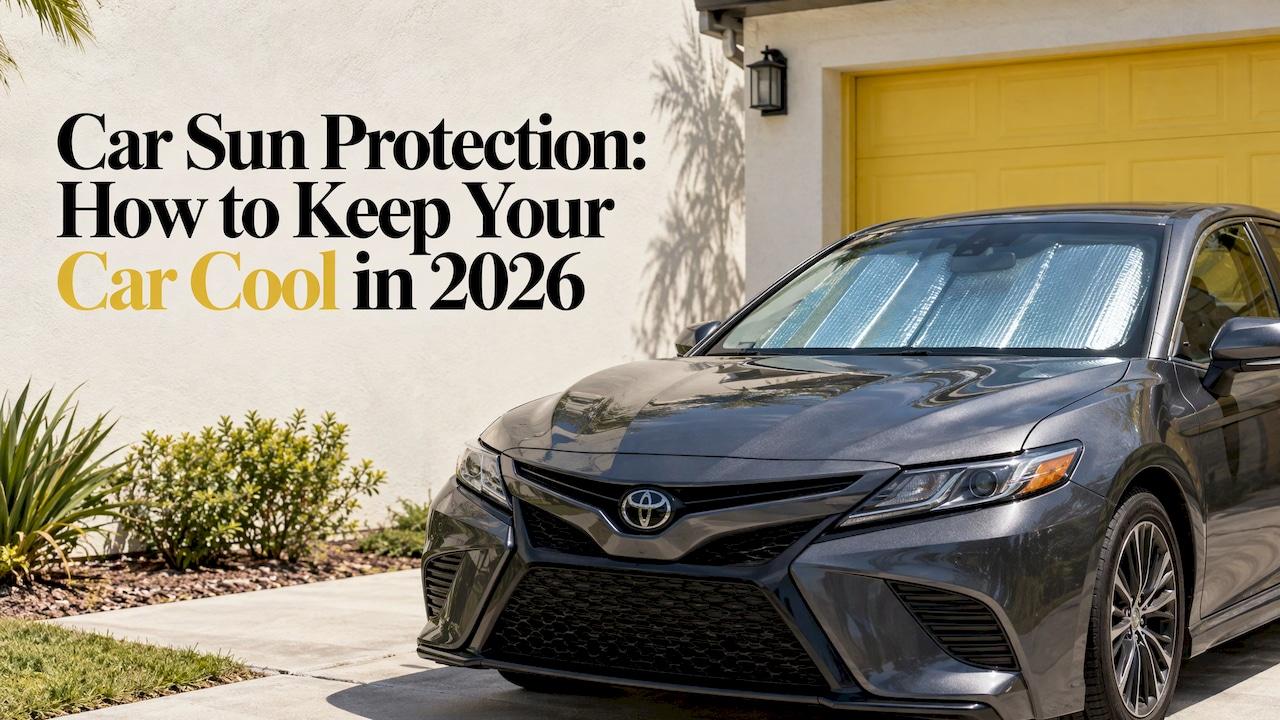
The best car sun protection is layered: park in shade when you can, put a shade on the windshield, and add ceramic window film so the glass itself blocks UV and a large share of the heat. Shades work while you are parked. Film works all day, parked or moving. In Volusia and Flagler Counties, where a car can sit in full sun for hours, the combination protects the dash, seats and your comfort.
This guide covers what each option does, what the tests show, how to choose and use each one, and where mobile tint fits in.
TL;DR
- A windshield shade measurably cuts heat on a parked car, and it helps most with the surfaces you touch, like the steering wheel and dash.
- Shade, a garage and a clean, conditioned interior are the habits automotive groups recommend for fighting sun damage.
- Quality automotive window film blocks up to 99% of UV and cuts glare. Ceramic film also targets infrared heat.
- Tint must follow Florida law, so choose a film and shade level that fits your vehicle type.
- We install ceramic film at your home, office or dealership lot across Volusia and Flagler Counties.
Table of Contents
- What the sun does to a parked car
- Free and cheap habits that help
- Do windshield sun shades work?
- Window film: sun protection that works while you drive
- Shade vs. film vs. both
- Know the tint rules before you choose a shade level
- Our perspective
- Protect your car where it is parked
- A simple sun protection plan for Florida drivers
- FAQ
- Sources
What the sun does to a parked car
Sunlight hits a car in three ways: visible light (glare), ultraviolet rays (fading and cracking) and infrared (heat). A closed car acts like a trap for all three.
The Florida Solar Energy Center measured this in Cape Canaveral, a short drive from Daytona Beach. Unshaded parked cars commonly reached interior air temperatures of 150°F and dashboard temperatures near 200°F. That study is old, but the physics has not changed, and the Florida sun has not either.
The damage is not just discomfort. A sunshade exists to protect the dashboard, seats and trim from UV rays that cause fading and cracking over time. Leather dries out, plastics warp and dash vinyl chalks. The AC also works harder every time you get in.
Free and cheap habits that help
Before you buy anything, the basics matter. AAA recommends parking in a garage or shade, using a windshield protector, window shade or car cover, keeping the interior clean, conditioning leather seats, adding seat covers and waxing the paint.
A few practical notes for Florida drivers:
- Park with the sun in mind. Morning shade from a building may become afternoon sun. Think about where the car will sit at 2 p.m., not 8 a.m.
- Wipe the dash. State Farm notes that a microfiber cloth removes particles that cause tiny scratches, and a low-gloss detailing product protects the dash and cuts glare.
- Condition leather on a schedule. Heat and UV pull moisture out of it. Seat covers are a simple barrier on seats that get the most sun.
- Wax the paint. Exterior protection counts too, since the sun hits the body as hard as the glass.
These habits help, but none of them stop the sun from coming through your windows while you drive. That is where shades and film come in.
Do windshield sun shades work?
Yes, with realistic expectations. Popular Mechanics ran a side-by-side test and found that after 30 minutes the shaded car was 10 degrees cooler. After an hour, the shaded car topped 90 degrees, while the unshaded car reached close to 120 and kept climbing.
The FSEC study found that a conventional cardboard shade cut interior air temperature by an average of 15°F and dashboard temperature by 40°F. Shades with a foil, low-emissivity backing did even better, 3 to 5°F cooler air and 6 to 11°F cooler steering wheel and dash than conventional shades.
A German club test reported by Carscoops adds useful nuance. An internal accordion shade lowered cabin air by only about 4°C (7.2°F), but shielded the steering wheel by as much as 26°C (46.8°F). In other words, it won't make the air cold, but it can be the difference between grabbing a steering wheel comfortably and burning your palms.

What a shade cannot do
A shade only works while you are parked, and heat still enters through the side windows, rear glass and roof. Motor1 describes a sun shade as a heat-reduction accessory, not a cooling system. It does not make a parked car safe for children or pets. Never leave either inside a parked car in Florida, shade or no shade.
Choosing and using a shade
- Fit matters most. CNN Underscored advises that custom-fit models do the best job of blocking sun, and that laminated foam resists moisture and lasts.
- Pick a style you will actually use. Per Autoweek, umbrella styles are the most compact, though wire tips can scratch a dash. Folding shades are the most popular because of low cost. Roll-up and accordion types are easy to deploy but bulky.
- Look for reflective material. Road & Track suggests a high UPF rating or a reflective layer like aluminum foil or Mylar.
- Use it every time. A shade that is a hassle to put up stops getting used.
Window film: sun protection that works while you drive
A shade covers the windshield for a few hours. Window film is applied to the glass and works on every window, whether the car is parked, idling or on I-95.
Manufacturer specifications show what quality film is designed to do. For example, 3M says its FX-PM automotive film blocks up to 99% of UV light and reduces up to 93% of glare, and that it is non-metalized, so it does not interfere with GPS, satellite radio or 5G phones. Avery Dennison's data sheet likewise states that its automotive films block greater than 99% of harmful UV rays and reduce glare and eyestrain.
The German test is worth noting here too. Tint on the rear glass lowered front-cabin air temperature by about 2°C and cut the rear bench surface temperature from 57°C to 48°C, according to the same Carscoops report. Film and shades do slightly different jobs, which is why they work well together.

Why ceramic
Dyed film mostly darkens the glass. Ceramic film uses ceramic particles designed to reject infrared, the part of sunlight you feel as heat, without needing a very dark look. A local news report from CBS Austin in 2019 cited a figure of up to 50% of solar heat rejected as infrared and interior reductions of up to 39 degrees in tests. Actual results depend on the film, the glass and the shade you choose.
That is why we install ceramic film only.
What you notice day to day
- A cooler cabin when you get in, and an AC that does not have to fight as hard. CNN Underscored notes that reducing heat load also helps AC life and electric vehicle range.
- Less squinting. Glare reduction matters on the long, flat, sunny stretches of A1A and US-1.
- Privacy for bags, laptops and kids in the back seat.
- Less fading on the dash, door panels and seats.
Shade vs. film vs. both
| Windshield shade | Ceramic window film | Both together | |
|---|---|---|---|
| Works while parked | Yes | Yes | Yes |
| Works while driving | No | Yes | Yes |
| Covers side and rear glass | Only with extra window shades | Yes | Yes |
| UV protection | Covers the windshield area | Applied to the glass itself | Most complete |
| Glare reduction | No | Yes | Yes |
| Daily effort | Put up and take down | None after install | Shade only |
Film is the always-on layer. A shade is the extra layer for the windshield, which is the largest piece of glass and the one facing the sun most of the day.
Know the tint rules before you choose a shade level
Tint darkness is regulated by state, and the rules differ widely. Kelley Blue Book notes that some states require 70% light transmission, while others prohibit aftermarket tint on the front windows. It adds that limits for SUVs and minivans can differ from those for sedans and coupes, and that commercial vehicles often face other rules.
For Florida specifics, including how the rules treat sedans versus SUVs and trucks, see our Florida tint law page. One of the advantages of ceramic is that you can get strong heat rejection without going to an illegally dark film, since the heat control comes from the film technology, not just darkness.
Our perspective
We tint cars all day in Volusia and Flagler Counties, and the pattern is the same on every driveway. People buy a shade first, which is a good start, then call us because the steering wheel, the side windows and the back seat still bake.
Our view is simple: a shade protects the windshield while you are parked, and film protects every window all the time. We only install ceramic film because heat is the problem you are trying to solve, and ceramic is built for it.
The install matters as much as the film. We bring a fully equipped mobile unit to your location, we do not rush, and we spend time on prep and fitment, because dust and sloppy edges are what you see every day afterward.
We back the work with a comprehensive warranty that includes no-fault coverage. Ask us about the specifics for your vehicle when you book.
Tint
Protect your car where it is parked
The hard part of tinting a car is usually the schedule: dropping it off, finding a ride and losing half a day. We come to your home, workplace or lot in Daytona Beach, Deltona, New Smyrna Beach, DeLand, Port Orange, Ormond Beach, Palm Coast, Edgewater and the surrounding area.
Our automotive ceramic tint packages include Pro Ceramic and Select Ceramic, plus options for sides and rear, front two windows, windshield and visor strip. Pricing is quoted per vehicle, so contact us for a quote.

If you manage a fleet or run a dealership, our dealer programs bring the same service to your lot. Our pro installation page explains how we work, and you can reach us from the Tint Monkeys homepage.
Heat is not just a car problem. If your living room gets hot in the afternoon, our residential window tint and commercial window tint services use solar control film to cut heat and UV at the glass, which can help with AC load.
A simple sun protection plan for Florida drivers
- Park smart. Use a garage or shade when you can.
- Add ceramic film. Choose a shade level that complies with Florida law, and have it installed properly.
- Use a custom-fit windshield shade when parked outside, especially at the beach, work or the store.
- Crack the windows slightly if it is safe and secure. CNN Underscored quotes an industry expert saying a good shade plus cracked windows can keep the interior 20 to 30°F cooler on a hot day.
- Care for the interior. Wipe the dash, condition leather, and use a low-gloss protectant.
- Never leave children or pets in a parked car. No product changes that.
FAQ
What is the best way to protect a car from the sun?
Use layers. Park in shade, put a custom-fit shade on the windshield and have ceramic film installed on the side and rear glass. Film works while you drive and park, and a shade adds protection at the windshield.
Does window tint protect a car's interior from UV?
Quality automotive film is designed to block most UV light. 3M and Avery Dennison both state their automotive films block 99% or more of UV, which helps slow fading and cracking of the dash and seats. Results vary by film, so ask which film we recommend for your vehicle.
Is a sun shade enough in Florida?
A shade helps a lot with the windshield, dash and steering wheel while you are parked. It does not cover the other windows or help while you drive. Many drivers pair it with ceramic film for all-day protection.
Can I get my car tinted at home or at work?
Yes. Our mobile units come to your chosen location in Volusia and Flagler Counties, so you do not need to drop the car off at a shop. Use the automotive page to see the packages and request a quote.
Sources
- AAA Club Alliance: Easy Steps to Protect Your Car from the Summer Sun
- State Farm: Protect Your Car From Damaging Effects of Sun and Heat
- Popular Mechanics: Do Car Sun Shades Work?
- Florida Solar Energy Center: Analysis of Radiant Barrier Car Shade Performance
- Road & Track: Best Car Sunshades
- Carscoops: ADAC sunshade heat test
- Motor1: Do Car Sunshades Work?
- CNN Underscored: The 8 best car sun shades
- Autoweek: Best Car Sunshades Tested
- 3M Automotive Window Film FX-PM Series
- Avery Dennison Encore Automotive Window Films data sheet
- CBS Austin: How to keep your car from becoming an oven
- Kelley Blue Book: Car Window Tinting