
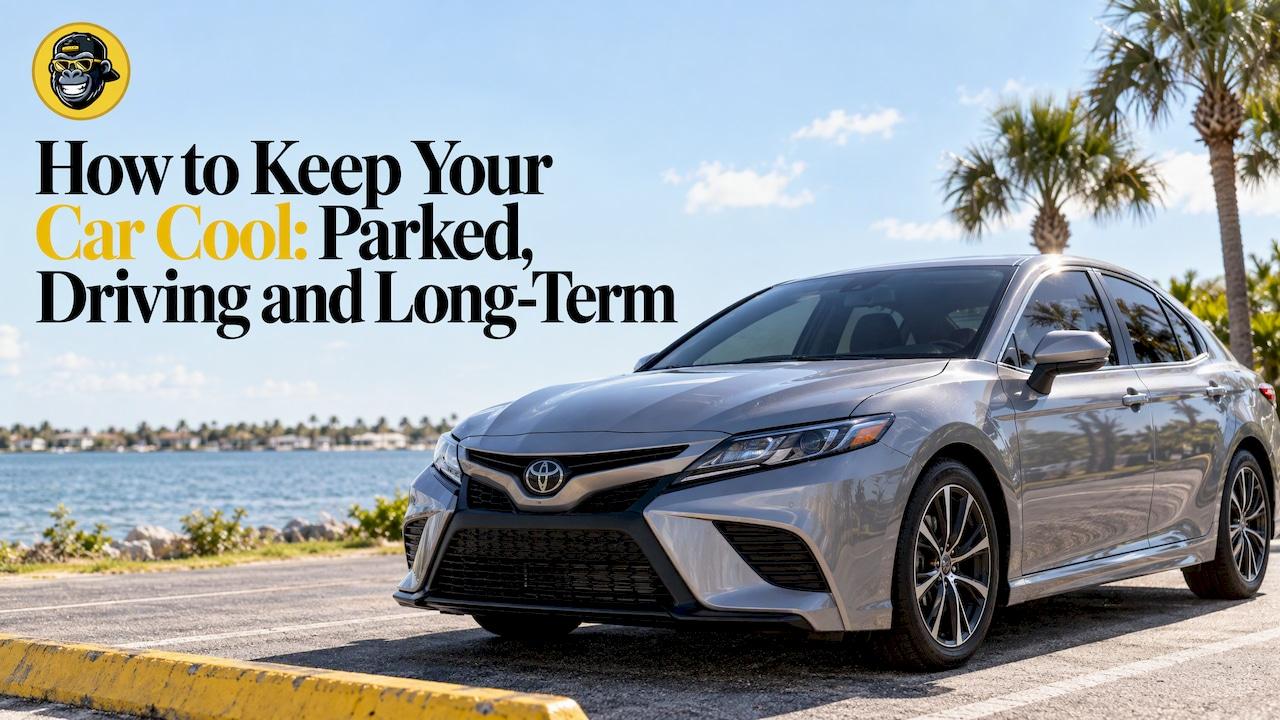
The best way to keep a car cool is to stack a few habits: park out of the sun, block light before it enters the glass, vent the hot air before you turn on the AC, and cut the heat that comes through the windows for good. The first three cost almost nothing. The last one is what ceramic window film is for. Below, you'll find what works, why, and how much each step is likely to help in a Volusia or Flagler County summer.
TL;DR
- Shade is the biggest free win. Rutgers reports shaded parking can keep a car up to 20 degrees cooler than direct sun.
- Vent first, then cool. Open the doors or windows to push out hot air, then run the AC, and switch to recirculation once the cabin cools.
- A windshield sunshade helps while parked. Ceramic window film works all day, parked or moving, on every window it covers.
- Never leave a child or pet in a parked car, even for a minute and even with the windows cracked.
Table of Contents
- Why a parked car gets so hot so fast
- Keep a parked car cool
- Cool down a hot car before and while you drive
- Stay cool when your AC is weak or off
- Why window tint is the fix that works every day
- Perspective
- Hot-car safety: what the tips above cannot do
- Book mobile ceramic tint in Volusia and Flagler
- A simple routine for the Florida summer
- FAQ
- Sources
Why a parked car gets so hot so fast
Sunlight passes through glass, heats the dashboard, seats and steering wheel, and those surfaces release the heat as warm air. The glass then keeps that heat inside. It is the same effect as a greenhouse.
The numbers are larger than most people expect. According to AAA Club Alliance, after 90 minutes on a 75-degree day, the inside of a vehicle can reach 120 degrees or higher. On an 80-degree day it takes only about 40 minutes. The same page notes that interior surfaces in direct sunlight can get close to 200 degrees.
The first ten minutes matter most. Rutgers University reports that the temperature can climb by 20 degrees in 10 minutes, even with the windows cracked. In Daytona Beach, where a July afternoon easily passes 90 degrees, a car at a beach lot or a shopping center reaches uncomfortable levels before you finish your errand.

Keep a parked car cool
Start with the habits that cost nothing, then add equipment.
Park in shade or a garage
AAA's Car Doctor advises parking in the shade or a garage when you can and staying out of direct sunlight. Rutgers puts a figure on it: shade can keep the cabin up to 20 degrees cooler.
A few practical habits for our area:
- At work, take the spot that gets shade in the afternoon, not the morning. The sun is hottest from about noon to 4 p.m.
- Park facing away from the afternoon sun if you can, so the windshield and dashboard get less direct light.
- Use garage levels or tree-covered lots at the beach, malls and medical offices.
Use a windshield sunshade
A sunshade is cheap and it works. A Florida Solar Energy Center study, reported by CBS Austin, found that ordinary cardboard shades cut the interior temperature by an average of 15 degrees and dashboard temperatures by 40 degrees. Foil-backed radiant barrier shades took off another three to five degrees.
AutoZone says shades start under $10 and typically stay under $30.
One caution from testing: a Carscoops test found that a cover draped over every glass surface and the roof kept the cabin 10 degrees C (18 degrees F) cooler than a bare car. A reflective film on the outside of the windshield gave an 8 degrees C (14 degrees F) improvement. The more glass you cover, the better. A windshield shade alone leaves your side and rear windows exposed.
Crack the windows, but only a little
Rutgers suggests cracking the windows about a half-inch when parked so heat can escape. AAA's advice is similar: a small gap lets in a breeze and still keeps out rain and thieves. Treat this as a small help. It does not make a car safe for a child or pet, as covered in the safety section below.
Cover the surfaces you touch
Light-colored towels over the seats and steering wheel keep those surfaces from becoming too hot to touch, a tip from Rutgers. Leather and dark vinyl hold the most heat. Rutgers also lists solar-powered fans to ventilate hot air.

Cool down a hot car before and while you drive
When you walk back to a car that has been baking, don't jump in and crank the AC to maximum. Follow this order:
- Open the doors and windows. AAA recommends letting the hot air out first. Rutgers suggests opening all the doors for 30 seconds, or rolling down opposite windows for cross-ventilation.
- Start the AC on fresh-air (ventilation) mode with the windows still down for a short stretch.
- Close the windows and switch to recirculation once the cabin starts to feel cooler, and raise the fan to its highest setting, per AAA.
- Aim the vents at passengers, not at the roof or floor.
The U.S. Department of Energy's fueleconomy.gov adds two points worth knowing. It says driving with the windows open briefly before using the AC lets the hot air out. It also advises against idling with the AC running before you drive. Roll the windows down at lower speeds and use the AC at highway speeds.
There is a cost to relying on AC alone. The same page says running the air conditioner in very hot conditions can cut a conventional vehicle's fuel economy by more than 25%, especially on short trips. Hybrids and electric vehicles can see an even larger percentage drop. Less heat entering the cabin means the AC works less.
Stay cool when your AC is weak or off
If the AC is struggling, these tips from Rutgers help:
- Mist your face and arms with a spray bottle of water. The evaporation cools you.
- Drink water before and during the drive.
- Drive in the cooler parts of the day, early morning or evening, when you can.
- Use a solar-powered fan while parked to ventilate.
These keep you comfortable. They do not cool the cabin much, so the long-term fix is to reduce how much heat gets in.
Why window tint is the fix that works every day
Shades and shade-seeking only work when you are parked and when you remember. Window film works the entire time the sun hits the glass: parked at a job site, stuck in traffic on I-95, or crossing the Granada Bridge at 3 p.m.
Ceramic films are built to block infrared heat and UV without needing a dark look. The CBS Austin report cited above says ceramic film can cut up to 50% of the solar heat that enters through windows as infrared light. It also says tests show interior temperatures down by as much as 39 degrees. That report is from 2019 and lists about $500 to $600 for film on all windows, so treat it as a rough guide. Your quote depends on your vehicle and the film you choose.
Rutgers also lists tinting windows, where legal, among the ways to reduce heat. Carscoops' testers recommend pairing a good windshield shade with rear tinting. That fits how we see it: use the shade for the windshield, and use film for the rest of the glass.
What to ask about tint rules
Tint limits in Florida depend on the window and the vehicle type, and they can change. A professional installer should be able to tell you which film levels are legal for your car and set you up accordingly. That is part of the job when you book a pro, so don't guess at percentages from a forum post.
Pick the right coverage
Our automotive window tinting lineup is built around ceramic film, with packages that let you match coverage to your budget and how you use the car:
| Option | What it covers | Good fit for |
|---|---|---|
| Pro Ceramic | Full-vehicle ceramic film | Drivers who want the most complete heat and UV control |
| Select Ceramic | Full-vehicle ceramic film | Drivers who want ceramic performance with a different film tier |
| Sides & Rear | Side and rear windows | Families and anyone with backseat passengers |
| Front Two | Front side windows | Adding comfort to the driver and passenger |
| Windshield | The windshield | Cutting sun glare and heat from the biggest piece of glass |
| Visor Strip | Top strip of the windshield | A lower-profile way to block overhead sun |
We don't publish fixed prices because they depend on the vehicle, so you get a quote for your car.
Perspective
Most of the heat in a car comes in through the glass, and most cooling tips fight it after it has already arrived. A shade only helps when you remember it, and AC only helps while the engine runs.
That's why we install ceramic-only film. It is designed to reduce heat, UV and glare on the windows themselves, so the cabin starts the day cooler and your AC has less to do.
We also think how the film goes on matters as much as which film you pick. Our mobile units come to you, and we take the time for careful prep and fitment instead of rushing. Our warranty includes no-fault coverage, so you are not left guessing if something goes wrong.
Tint
Hot-car safety: what the tips above cannot do
Every cooling tip in this article makes a car more comfortable. None of them makes a parked car safe for a child or a pet.
- The National Highway Traffic Safety Administration (NHTSA) says a child's body temperature rises three to five times faster than an adult's, and a car can reach dangerous temperatures even at 60 degrees outside with the windows cracked.
- The National Safety Council says a parked car can heat up 19 degrees in 10 minutes even with the windows cracked.
- NHTSA reports that 31 children died of heatstroke in vehicles in 2025.
NHTSA's guidance is simple. Never leave a child in a vehicle unattended for any length of time. Check the whole vehicle, especially the back seat, before you lock the doors. Put a personal item such as a bag or a shoe in the back seat as a reminder. Ask your childcare provider to call you if your child doesn't arrive.
If you see a child or pet alone in a hot car, call 911. If someone shows signs of heat illness, such as heavy sweating, hot red skin, a rapid pulse, dizziness, confusion, nausea or vomiting, the National Weather Service says to get medical attention immediately.
Film, shades and shade do not change this. Treat them as comfort tools, not safety tools.
Book mobile ceramic tint in Volusia and Flagler
If you are tired of the steering wheel burning your hands every afternoon, we can come to you. Tint Monkeys installs ceramic film at your home, workplace or wherever the car is parked, using fully equipped mobile units. You don't need to give up half a day at a shop.

We serve Daytona Beach, Deltona, New Smyrna Beach, DeLand, Port Orange, Ormond Beach, Palm Coast, Edgewater and the surrounding area. See the automotive tint options and request a quote for your vehicle. Local pages are also available for Palm Coast and DeLand. For more on the topic, read our guide to car sun protection.
The same logic applies at home and at work. Sun-heated rooms push up AC bills, and our residential window tint and commercial window tint services use the same approach for glass that faces the sun.
A simple routine for the Florida summer
Here is how the pieces fit into one routine:
- Morning: Park in a spot that will be shaded after noon. Keep a light towel over the steering wheel if it is dark.
- At every stop: Use a windshield shade, and a half-inch window gap only if the car is empty and the weather is dry.
- When you return: Open the doors for 30 seconds, start the AC on fresh air, then close up and switch to recirculation.
- Over the long term: Add ceramic film so your cabin stays cooler on every drive without the daily effort.
- Every time: Look in the back seat before you lock.
FAQ
What is the fastest way to cool down a hot car?
Open the doors or all the windows for a minute or so to let the hot air out. Then run the AC on fresh-air mode, close the windows, and switch to recirculation with the fan on high. This order is what AAA recommends. It works faster than closing everything and running the AC at full blast.
Does a sunshade really keep a car cooler?
Yes. A Florida Solar Energy Center study found cardboard windshield shades cut the cabin temperature by an average of 15 degrees, per CBS Austin's report. A shade covers only the windshield, so heat still comes in through the other windows. Many drivers pair a shade with film on the rest of the glass.
Does ceramic window tint keep a car cooler?
Ceramic film is designed to block infrared heat and UV, and a 2019 report cites tests with interior temperatures reduced by up to 39 degrees. Results depend on the film, the vehicle and how much glass is covered. We install ceramic-only film for that reason, and we can recommend coverage for your car.
Is it okay to leave the windows cracked to keep a car cool?
Cracking the windows slightly helps heat escape, but only a little. Rutgers reports that a car can still rise by 20 degrees in 10 minutes with the windows cracked. It is never a reason to leave a child or pet in the car.
Does running the AC use a lot of fuel?
It can. Fueleconomy.gov says AC use in very hot weather can reduce a conventional vehicle's fuel economy by more than 25%, especially on short trips. Venting hot air first and reducing the heat entering the cabin both ease the load.
Sources
- AAA Northeast: How to Keep Your Car Cool in Summer
- AAA Club Alliance: Protect Your Car from the Summer Sun
- Rutgers University: Hot Cars, Hidden Dangers
- CBS Austin: How to keep your car from becoming an oven this summer
- AutoZone: How to Keep Your Car Cool in the Summer
- Carscoops: Windshield sunshade heat test
- fueleconomy.gov: Fuel Economy in Hot Weather
- NHTSA: Summer Driving and Road Trip Tips
- NHTSA: Child Heatstroke Prevention
- National Safety Council: Hot Cars Talking Points
- National Weather Service: Outdoor Activities, Heat Safety and Preparedness